
Can Non-Residents Get a Free N1 London Registered Office for 12 Months With Privacy Shield?
Get a free N1 London registered office for 12 months with Privacy Shield. Protect your home address, enhance business privacy, and establish a professional UK presence while managing your company from abroad.
Yes. Non-Resident UK Company Formation provides a free N1 London registered office for 12 months with its Non-Resident Privacy Shield package. The address replaces your home address on the public Companies House register and receives official government correspondence for your UK limited company.
What Does the Free N1 London Registered Office Include?
The offer covers a London N1 registered office address for the first 12 months of your company. It comes bundled with the Non-Resident Privacy Shield package. Companies House lists this address as your official company location.
A registered office is the legal address of a UK limited company. Companies House records it on the public register at incorporation. Every company formed in England and Wales holds one.
The N1 postcode places your company in North London, within the Islington area. This is a recognised business location. It gives a company founded abroad a credible UK presence from the first day.
The 12-month term runs at no charge. You pay nothing for the address during that period. The address is attached to the Privacy Shield package, so you receive it when you register your company through the service.
The address is a real physical location. Companies House requires every registered office to be a genuine UK address where documents can be delivered. A PO Box fails this test. An N1 registered office passes it.
Why Does a UK Company Require a Registered Office Address?
UK law requires every limited company to hold a registered office in the country of incorporation. The address receives official notices from Companies House and HMRC. It also appears on the public register for anyone who searches the company.
The Companies Act 2006 sets this rule. A company registered in England and Wales must keep a registered office in England or Wales. The rule applies regardless of where the directors or shareholders live.
Three types of official post arrive at this address: statutory notices from Companies House, tax correspondence from HMRC, and legal documents such as court papers. A missed document can trigger penalties or strike-off action. A reliable UK address therefore protects your company's good standing.
Since March 2024, Companies House also requires an "appropriate address." The address must allow a person to deliver documents and obtain an acknowledgement of receipt. Non-residents who read our guide on whether a UK company needs a registered office in the UK find the full legal background there.
Directors based overseas cannot use a foreign home address as the registered office. The address must sit inside the UK. This is the reason most non-resident founders buy or receive a UK address service.
How Does Privacy Shield Protect a Non-Resident's Personal Address?
Privacy Shield replaces your personal address on public records with the London N1 registered office. Companies House publishes registered office details openly. Using a business address keeps your home location off the searchable register.
Companies House is a public database. Anyone with an internet connection can search company records at no cost. A registered office entered as a home address becomes visible to the public.
Founders living outside the UK often enter an overseas home address. That address then appears in search results, in downloaded filings, and in third-party data sites. Data aggregators copy this information, and removing it later is slow.
The Non-Resident Privacy Shield package prevents this exposure at the point of incorporation. Your company files with the N1 address from the start. Your home address does not enter the public record as the company's registered location.
This approach matches the purpose of a registered office. The address exists for official delivery of documents. It does not exist to disclose where a director lives.
How Does a London Registered Office Compare With Other Address Options?
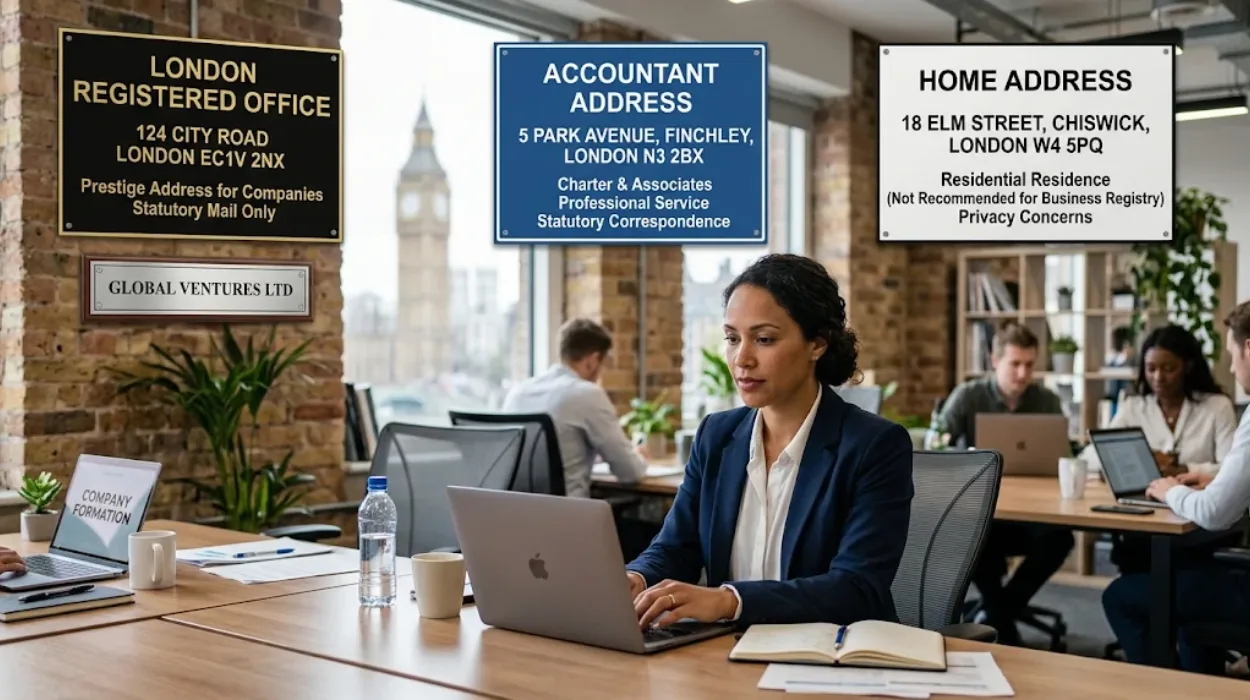
A London registered office offers a professional, physical address that Companies House accepts. An accountant's address works but ties your company to that firm. A home address exposes private details. Each option carries different privacy and control outcomes.
Three address types dominate non-resident company formation: a London registered office, an accountant address, and a home address. Each differs in privacy, flexibility, and independence.
An accountant address depends on the accountant relationship. If you change accountants, the address changes too. You then file a change of registered office with Companies House. This adds administrative steps to every transition.
A home address is the simplest option on paper. It is also the least private. For non-residents, it is often outside the UK, so it fails the UK address requirement entirely.
A dedicated London registered office remains independent of your accountant. You keep the same address if you switch advisers. Our comparison of London registered office vs accountant address vs home address for non-residents sets out the full evaluation criteria.
How Fast Can a Non-Resident Form a UK Company With This Offer?
A company forms online in as little as 3 working hours when you submit complete and accurate information. All legal and ID checks must finish first. Processing times follow Companies House and exclude weekends and bank holidays.
The 3-hour timeline depends on four conditions. The application must be complete. The information must be accurate. The identity checks must pass. The legal checks must clear.
Once approved, you receive your Web Filing Authentication Code online through your company summary page. This code lets you file documents with Companies House. Keep it secure, because it authenticates every future filing.
Delays occur in three situations. Incomplete information stalls the application. Incorrect documents force a resubmission. Technical or application-related complexities require extra processing. Submit a full application on the first attempt to avoid all three.
Companies House counts only working days. Weekends and bank holidays pause the clock. A Friday evening submission may not reach review until Monday.
Who Benefits Most From the Free 12-Month N1 Registered Office?
Non-UK residents forming a UK limited company benefit most. The offer suits entrepreneurs who want a UK address without owning UK property. It also suits founders who want personal details kept off the public register.
Three groups gain the most. First, overseas entrepreneurs who trade with UK customers and want a UK business presence. Second, founders who open UK bank accounts and payment processors that expect a UK company address. Third, directors who value personal privacy and refuse to publish a home address.
The free 12-month term gives you a full year to build the company. You register the company, set up filings, and begin operations. You then review the address arrangement before the term ends.
Business support follows incorporation. Annual confirmation statements, accounts, and corporation tax filings all reference the registered office. A stable address keeps these filings consistent year after year.
Is the Free N1 Registered Office the Right Choice for Non-Residents?
Yes, for founders who want a credible London address and personal privacy from day one. The N1 registered office meets Companies House requirements. Non-Resident Privacy Shield delivers both compliance and address protection in one package.
The facts support the decision. Companies House requires a UK registered office. The register is public. A home address placed on it stays visible to anyone searching.
Non-Resident UK Company Formation serves non-UK residents exclusively. The service structures formation, the N1 registered office, and post-incorporation administration around the needs of overseas founders. The Non-Resident Privacy Shield package combines these elements in a single route to incorporation.
Review your own requirements against the three address options. Confirm that your information is complete before you apply. A complete application supports the 3-hour formation window.



0 comments
No comments yet — be the first to share your thoughts.