
How Can a New UK Company Show Up on Google?
Learn how to make your new UK company appear on Google with effective SEO, Google Business Profile setup, website optimisation, and online visibility strategies that help customers discover your business and build trust.
A new UK company shows up on Google by completing incorporation, publishing a crawlable website, submitting it to Google Search Console, and verifying a Google Business Profile where eligible. Consistent company details across these platforms help Google validate the business as a legitimate entity.
How Quickly Can a Non-Resident Form a UK Company Online?
A non-resident can form a UK company online in as little as 3 working hours. This applies when complete, accurate information is submitted, and all legal and ID checks finish successfully. Companies House processing times exclude weekends and bank holidays.
Incorporation creates the legal entity that every later search presence depends on. Google Business Profile reviewers, directories, and banks all validate a business name against official records. A company without a registered record has no verifiable identity to publish.
Your Web Filing Authentication Code is provided online through your company summary page. This code authorises future filings with Companies House. It is available as soon as the company is registered.
Delays occur when information or documents are incomplete or incorrect. Technical or application-related complexities also require additional processing. Submitting accurate director details, a valid registered office address, and the correct share structure on the first attempt keeps the timeline short.
The Non-Resident Basic Setup for UK company registration covers this first stage for non-UK residents. It delivers a registered limited company that anchors every later step in the search visibility process.
Why Does a New UK Company Not Appear on Google Immediately?
Google discovers businesses by crawling web pages and storing them in its index. A brand-new company has no pages, backlinks, or history, so Google has nothing to retrieve. Visibility begins after Google crawls and indexes at least one page tied to the company.
Google processes more than 8 billion searches daily and holds roughly 90% of global search share. Every one of those results comes from an index of crawled pages. A company that publishes nothing adds nothing to that index.
A Companies House register entry confirms legal existence. It does not create a search listing for your trading brand. The register is a separate public database, and Google ranks web pages rather than registry records.
Search visibility moves through three stages: crawling, indexing, and ranking. Crawling means Googlebot finds a page. Indexing means Google stores and understands the page. Ranking means Google orders the page against competing results for a query.
New companies stall at the first stage because no page links to them. Google follows links to discover content. A site with zero inbound links and no submitted sitemap waits longer for its first crawl.
How Does a Website Help a New UK Company Rank on Google?
A website gives Google a crawlable source of business information. Pages describing services, the company name, and contact details let Google match the company to relevant searches. Submitting the site through Google Search Console accelerates discovery and reports indexing status.
Google Search Console is a free tool from Google. It confirms which pages are indexed, flags crawl errors, and shows the queries that trigger impressions. Verify ownership of the domain first, then submit an XML sitemap.
Three on-page elements carry the most weight for a new company site: title tags, service pages, and a contact page. Title tags tell Google the page topic. Service pages describe what the company sells and to whom. The contact page confirms the legal company name, registered office address, and company number.
Three technical elements support those pages: HTTPS encryption, mobile-friendly layouts, and fast load times. Google uses mobile-first indexing, so the mobile version of each page determines how Google evaluates it. Compress images and remove unused scripts to cut load time.
Structured data adds a further layer. Organisation schema markup labels the company name, logo, URL, and contact details in a format search engines read directly. This markup supports entity recognition, which links your website to your registered company.
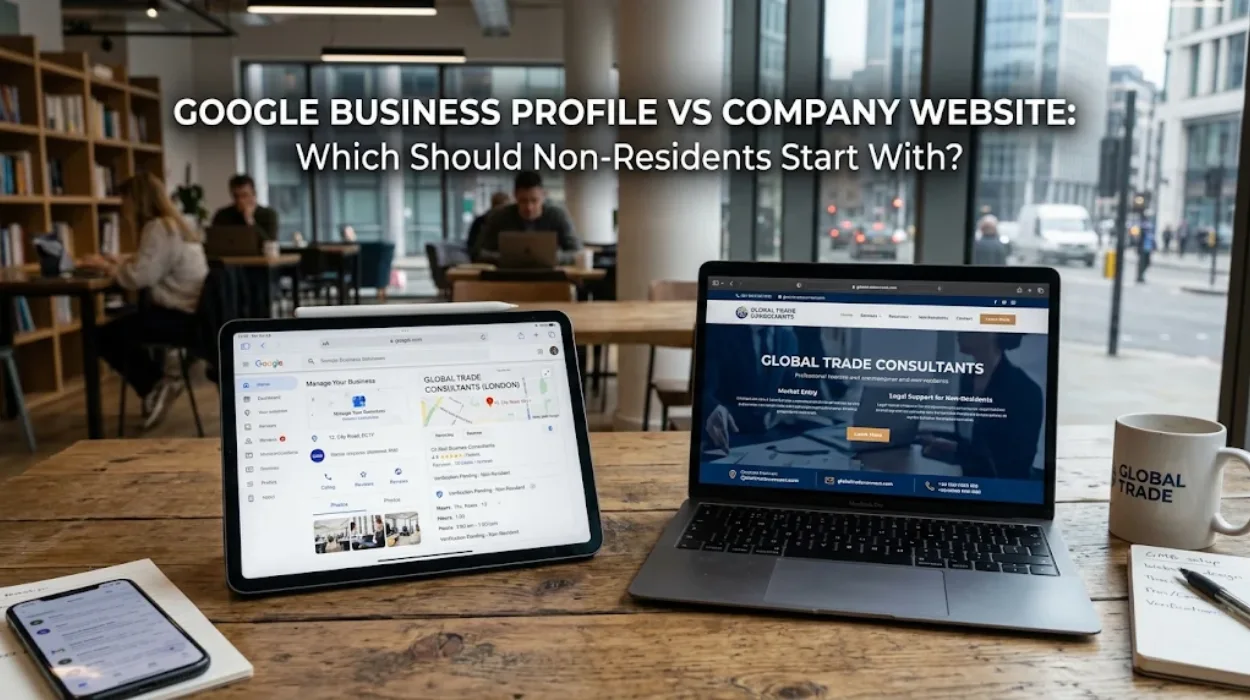
Non-resident founders frequently ask which asset to build first. The article Google Business Profile vs Company Website: Which Should Non-Residents Start With? compares both options by eligibility, setup effort, and search impact.
What Role Does Google Business Profile Play in Local Visibility?
Google Business Profile controls how a company appears in Google Maps and local search results. Google restricts eligibility to businesses that meet customers in person or serve a defined area. Verification confirms the listed details match a real business.
Google's guidelines require a Business Profile to represent a business with in-person contact with customers. Storefronts, service-area businesses, and offices that receive clients qualify. A purely online company with no in-person contact does not qualify under these guidelines.
A registered office address alone does not establish eligibility. It is a legal address for official correspondence. Google evaluates whether customers actually visit the location or receive service there.
Verification uses one of several methods: postcard with a code, phone call, email, or video recording. Google assigns the available method per business. Each method confirms that the owner controls the listed location.
Consistency matters after verification. Match the business name, address, and phone number exactly across the Business Profile, website, and directory listings. Search engines compare these three data points to confirm the entity is the same everywhere. Mismatches such as "Ltd" in one place and "Limited" in another weaken that confirmation.
Complete every profile field: business category, opening hours, services, and description. A complete profile gives Google more attributes to match against local queries.
Which Signals Build Trust for a New Company in Search Results?
Google evaluates trust through consistent business details, authoritative backlinks, and verifiable information. A registered UK company name, a matching registered office address, and a Companies House record give Google official data points to cross-reference against your website.
Google's quality guidelines describe four trust factors: experience, expertise, authoritativeness, and trustworthiness. New companies build these factors through published evidence. Author biographies, service descriptions, and accurate legal disclosures supply that evidence.
Three signals carry weight for newly incorporated companies: official registration data, consistent directory citations, and relevant backlinks. Official registration data comes from Companies House. Directory citations include listings on trade associations and business directories. Backlinks come from other websites that link to yours.
Place the company name, number, and registered office address in the website footer. This practice lets users and search engines match the site against the public register in seconds. It also complies with UK rules requiring companies to display certain details on their websites.
Backlinks from relevant, reputable sites pass authority to a new domain. Industry publications, supplier websites, and professional associations are credible sources. Ten links from relevant sites outweigh one hundred links from unrelated directories.
Starting from a properly registered entity makes each signal easier to verify. The Non-Resident Basic Setup provides that registered foundation, so your website, directory listings, and Google profile all reference the same legal company details.
How Long Does It Take for a New UK Company to Rank on Google?
New websites typically take three to six months to gain consistent search visibility. Indexing occurs within days of submission. Ranking for competitive terms takes longer because Google builds trust through content depth, backlinks, and user engagement over time.
Indexing and ranking run on different timelines. Google often indexes a submitted page within a few days. Ranking on the first page for a competitive query takes months of accumulated signals.
Search terms divide into two groups. Branded queries contain the company name and rank quickly once the site is indexed. Non-branded queries describe a service or product and compete with established sites.
Publish content that answers specific questions your customers search. Each page targets one query and covers it in full. Ten focused pages on ten distinct topics build topical authority faster than one page covering everything.
Track progress in Google Search Console. Four metrics show momentum: indexed pages, impressions, clicks, and average position. Rising impressions before rising clicks is the normal pattern for a new site.
What Is the Next Step for a New UK Company Seeking Google Visibility?
Complete incorporation first, then publish a website and submit it to Google Search Console. Add a verified Google Business Profile where eligible. Each step builds on the registered company record.
The sequence matters because each platform verifies information against the previous one. Companies House confirms the legal entity. The website presents that entity publicly. Search Console and Business Profile connect it to Google's systems.
Non-Resident UK Company Formation provides UK company incorporation exclusively for non-UK residents. Through Non-Resident Basic Setup, international founders register a limited company online and receive their Web Filing Authentication Code on the company summary page. This produces the verified legal record on which website publishing and search visibility are built.



0 comments
No comments yet — be the first to share your thoughts.