
How Do Overseas Directors Receive Official Letters Sent to Them Personally?
Learn how overseas directors receive official letters sent to them personally when managing a UK company. Understand mail handling, secure forwarding options, and practical ways to stay informed while living abroad.
Overseas directors receive official letters at a UK service address, where a mail handling provider scans the post and forwards it digitally or by courier. Companies House and HMRC post to the registered office and director service address, so a UK-based address keeps correspondence reaching the director.
What Counts as Official Mail Sent to a Director Personally?
Official director mail covers statutory letters addressed to an individual director by name. Examples include Companies House notices, HMRC correspondence, identity verification prompts, and legal documents served on the director rather than on the company itself.
Three categories of letters reach directors: regulatory notices, tax correspondence, and legal service documents. Each category carries a response period, so delivery speed affects compliance directly.
Regulatory notices come from Companies House. They relate to appointments, changes to personal details, and director identity verification under the Economic Crime and Corporate Transparency Act 2023. Tax correspondence comes from HMRC and covers Corporation Tax and company filing matters. Legal documents arrive from courts, solicitors, and creditors.
Ordinary international post takes days or weeks to cross borders. A director living outside the UK therefore reads a letter long after its date of issue. A UK delivery point removes that delay.
Where Does Companies House Send Director Correspondence?
Companies House sends company correspondence to the registered office and director correspondence to the service address held on the public register. Where a director supplies no separate service address, the residential address on file receives the post.
Every UK company holds a registered office in the United Kingdom. Companies House writes to that address with confirmation statement reminders, accounts reminders, and compulsory strike-off warnings. The registered office is the primary legal delivery point for the company.
Each director also supplies a service address. Companies House publishes it on the register. An overseas director's service address can sit anywhere in the world. A UK service address shortens delivery time and keeps statutory post inside the UK postal network.
Why Does a Service Address Differ From a Residential Address?
A service address is public and receives official post. A residential address is private and sits on a protected record. Separating the two keeps a director's home location off public search results while preserving a lawful delivery point.
The Companies Act 2006 lets directors give a service address for official communications. Companies House displays that address to anyone who searches the register. Search engines index these records, so a home address entered as a service address becomes publicly visible.
Companies House holds the residential address on a protected record. It discloses that record only to specified public authorities and credit reference agencies. A director who enters a separate service address keeps the home address off the public page.
This distinction matters most for overseas directors. A foreign home address on a UK register reveals the director's country, city, and street to any visitor. A UK service address replaces that detail with a neutral delivery point.
How Do Overseas Directors Receive Mail at a UK Service Address?
A mail handling provider receives post at the UK address, opens or scans it according to the director's instructions, and sends a digital copy to the director. Original documents travel by international courier on request.
The process runs in five steps: receipt, logging, scanning, notification, and forwarding. The provider receives the envelope at the UK address and records its arrival. The provider scans the contents, then alerts the director by email. The director reads the letter online and instructs the provider to forward, store, or shred the original.
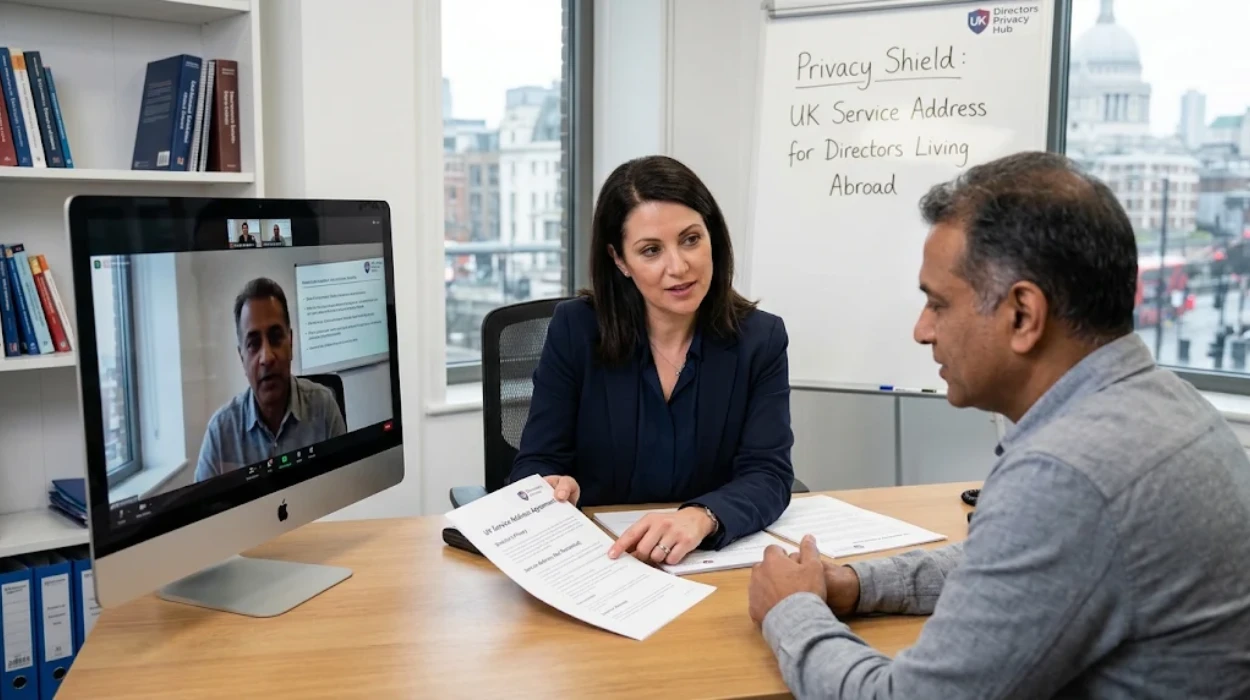
The Non-Resident Privacy Shield package provides a UK service address and handles director mail for overseas directors. Non-Resident Privacy Shield replaces the director's home address on the public register with a UK address. The director still receives every official letter in digital form.
Scanning creates a dated record of each item received. That record supports internal compliance files and gives accountants a reference point for filing deadlines.
What Deadlines Attach to Official Letters From Companies House and HMRC?
Companies House requires a confirmation statement every 12 months and annual accounts within 9 months of the financial year end. HMRC requires the Corporation Tax return within 12 months of the accounting period end.
Three deadlines govern most official letters: the confirmation statement, the annual accounts, and the Corporation Tax return. Companies House sends reminders before each filing date. HMRC issues a notice to deliver a Company Tax Return after the accounting period closes.
Late filing triggers financial penalties. Persistent failure to file leads Companies House to begin the compulsory strike-off process, which removes the company from the register. A company struck off cannot trade, hold assets, or open accounts under its former status.
Director letters carry response periods of their own. Identity verification requests, for example, specify a date for completion. An overseas director who reads the letter promptly completes the step before the date passes. Directors comparing delivery methods find the service address options for non-resident directors useful when evaluating providers.
How Does Digital Mail Handling Improve Compliance for Overseas Directors?
Digital mail handling shortens the gap between delivery and director review. A scanned copy reaches the director in the provider's processing window, so the director acts on statutory deadlines before response periods expire.
Postal forwarding adds transit days. Digital scanning removes them. A director in any time zone opens the scan on the day it arrives, then passes the document to an accountant or company secretary.
Digital copies also produce a searchable archive. A director locates a past Companies House notice by date or sender in seconds. Paper forwarded across borders sits in a drawer, and customs delays occasionally hold it for weeks.
Three safeguards protect director mail under a managed service: logged receipt, secure scanning, and controlled disposal. Logged receipt confirms delivery. Secure scanning limits who sees the contents. Controlled disposal destroys originals the director no longer wants. Each safeguard supports data protection duties under UK GDPR.
Digital handling also separates privacy from reachability. The public register shows the UK service address. The director's residential address stays private. Official letters still arrive without gaps.
What Is the Practical Answer for Overseas Directors?
Overseas directors register a UK service address, route official post to a mail handling provider, and read scanned copies online. This method delivers Companies House and HMRC letters quickly while protecting the director's home address from public view.
Official letters reach overseas directors through a clear chain. Companies House and HMRC post to the registered office and service address. A provider scans each item. The director reads it, acts on it, and files on time.
Non-Resident UK Company Formation supports this chain for non-UK residents through the Non-Resident Privacy Shield service. The service address handles delivery, and the register protects the director's residential details. The result is consistent receipt of statutory correspondence from any country, with filing deadlines visible well before they fall due.



0 comments
No comments yet — be the first to share your thoughts.