
How Can You Shield Your Overseas Home Address From Companies House Public Scrutiny?
Discover how non-UK residents can protect their overseas home address from public Companies House records using professional UK registered office and director service address solutions.
You shield your overseas home address from Companies House public scrutiny by appointing an official UK service address and registered office address during formation. This legal substitution replaces your personal residential details on the public register, ensuring total privacy while maintaining statutory compliance.
Setting up a business entity in the United Kingdom offers non-resident entrepreneurs access to a prestigious international jurisdiction. However, UK company law enforces strict public disclosure rules that mandate transparency for all corporate entity officers. When international directors complete standard incorporation applications, their listed addresses enter a searchable public database. Understanding how statutory address registers operate enables overseas founders to protect their personal privacy while meeting all legal standards set by the Registrar of Companies.
What Information Does Companies House Disclose to the Public?
Companies House discloses company names, director names, appointment dates, official service addresses, registered office addresses, and partial dates of birth on the public register. This information remains accessible to anyone searching the corporate registry online.
The Companies Act 2006 dictates that corporate transparency protects creditors, consumers, and commercial partners. When an individual registers a company limited by guarantee or limited by shares, the public database stores specific operational and personal identity data.
Three specific public registers hold director and company data:
The Register of Directors, which displays legal names, nationalities, occupations, and service addresses.
The Register of Secretaries, which stores statutory correspondence details for appointed corporate secretaries.
The Register of Persons with Significant Control (PSC), which records details of individuals holding more than 25% voting rights or share capital.
If a founder registers their residential address as the primary correspondence point, search engines and automated scraper tools index that home location as a permanent record. This public visibility leaves overseas directors vulnerable to unsolicited commercial mail, marketing cold calls, and physical privacy breaches.
How Does a Service Address Differ From a Residential Address?
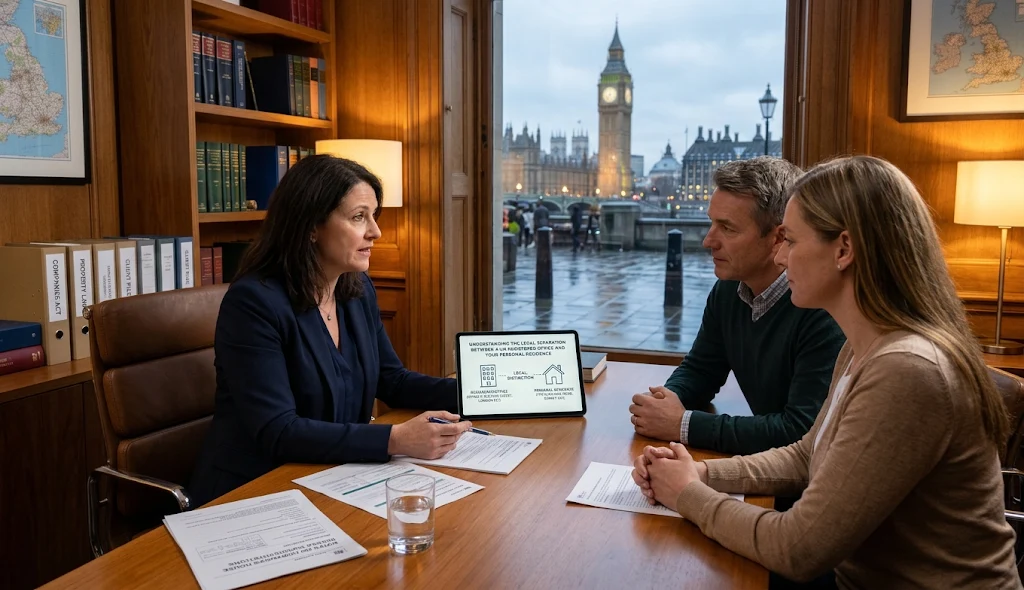
A service address acts as an official correspondence point for legal notifications, while a residential address is the physical home location of the director. Statutory frameworks allow directors to display a service address publicly to keep home details private.
UK company law requires every appointed director to provide two distinct addresses during the incorporation procedure:
Usual Residential Address (URA): The true residential address where the director resides.
Service Address: The official correspondence address for receiving statutory mail from regulatory bodies like HM Revenue and Customs (HMRC) and Companies House.
Companies House protects the Usual Residential Address in a secure internal database. Regulatory authorities and designated credit reference agencies retain restricted access to URA records under statutory guidelines. The general public cannot view the URA unless the applicant submits that same home address as their public service address or registered office address.
Using a non-residential UK location as your formal correspondence point ensures that public queries, formal legal notices, and official government letters are routed to a secure address location without exposing your private residence.
Why Must Non-Resident Directors Use a UK Registered Address?
Non-resident directors must use a UK registered address because UK law demands a physical jurisdiction point within England, Wales, Scotland, or Northern Ireland. Statutory legal documents and tax notices require verification within the UK boundary.
Every UK limited company must maintain a registered office address within its jurisdiction of incorporation. This location serves as the legal domicile of the corporate entity. Official agencies deliver statutory notices, court summonses, and revenue compliance demands directly to this destination.
International founders residing outside the UK face geographical limitations. Companies House rejects international addresses for the company's registered office. Overseas entrepreneurs utilize specialized corporate address options to fulfil legal criteria. Selecting a dedicated London location gives global entities an operational base while keeping all personal non-UK residential records completely off the public record.
For entities structured without share capital, securing a Non-Resident Limited by Guarantee with Privacy Package guarantees both legal compliance and complete address anonymisation right from initial submission.
How Can Global Founders Implement Complete Address Privacy?
Global founders implement complete address privacy by using professional address management services for both the registered office address and the director service address. This dual substitution keeps personal home locations fully off the public database.
Achieving total privacy requires covering every entry point on the incorporation application. A company submission features two mandatory address categories that appear on public files: the corporate registered office and the personal service address of each officer.
Two steps complete full privacy protection:
Designate a professional UK corporate address as the registered office.
Assign that professional UK address as the director service address for all officers and Persons with Significant Control (PSCs).
When complete and accurate information is submitted, and all necessary legal and identity checks are completed, a company can be formed online in as little as 3 working hours. Your Web Filing Authentication Code will be provided online through your company summary page. Processing times depend on Companies House processing and exclude weekends and bank holidays. Delays can occur where information or documents are incomplete or incorrect, or where technical or application-related complexities require additional processing.
International entrepreneurs evaluating address options often review structural differences across top commercial locations. Reading our analysis on Comparing N1 London Service Addresses vs. Personal Residential Listings for Global Founders clarifies how prime location selections influence company credibility and privacy safeguards.
Can You Remove a Home Address After It Becomes Public?
You can remove a home address from the public register by submitting a formal application under Section 1088 of the Companies Act 2006. This process requires providing an alternative UK service address to replace the residential entry.
If an international director accidentally registers their home address as a service address, the details become an immediate public record. Removing historical entries requires filing specific administrative forms with Companies House.
Three procedural actions resolve historical address exposure:
Secure an alternative valid UK service address location.
File form CH01 to update the current director service address on the active register.
Apply under Section 1088 regulations to redact historical documents containing the home address details.
Previous registered office entries remain visible on historic filings for the lifetime of the entity. Preventing exposure during initial setup avoids tedious administrative application filings later.
What Compliance Standards Apply to Address Service Providers?
Address service providers must comply with UK Anti-Money Laundering Regulations, Know Your Customer standards, and identity verification laws. Providers validate officer identity documents before approving the use of their UK corporate address.
Professional corporate service agents operate under strict regulatory oversight from UK authorities. The Money Laundering, Terrorist Financing and Transfer of Funds Regulations 2017 require address providers to verify the legal identity and residential location of every client officer.
Three verification steps complete compliance approval:
Collect government-issued photo identification such as valid passports.
Authenticate proof of residential address using recent utility statements or bank documents.
Perform electronic identity matching against international compliance databases.
These security checks ensure that official address services remain legitimate, secure, and fully compliant with UK corporate governance mandates.
Securing Your UK Entity Privacy
Protecting personal address information on public registers requires proactive structural planning during incorporation. Non-Resident UK Company Formation provides dedicated corporate privacy packages designed specifically for non-UK residents. Utilising professional UK registered office locations and official director service addresses allows international founders to maintain absolute residential privacy, comply with all statutory regulations, and establish a corporate entity with confidence.



0 comments
No comments yet — be the first to share your thoughts.