
Why Do Overseas Founders Need Physical Records Alongside Digital UK Corporate Filings?
Overseas founders must maintain physical company records alongside digital UK corporate filings to support compliance, protect important documents and ensure accurate business administration from abroad.
Overseas founders need physical UK corporate records alongside digital filings to satisfy international banking compliance, comply with foreign notarisation requirements, and present official proof of company legal status to non-UK government authorities.
Why Do Digital UK Corporate Filings Require Physical Verification Abroad?
Digital UK corporate filings require physical verification abroad because foreign authorities, international banks, and overseas registries often refuse unverified digital downloads. Overseas institutions demand physical corporate documents bearing legal signatures or official apostilles to establish corporate authenticity under international legal standards.
Digital company registration through Companies House provides instant online access to corporate records. However, cross-border business transactions operate under different legal frameworks. Foreign banks in jurisdictions outside the United Kingdom rarely accept standalone digital certificates downloaded from a web browser. Overseas financial institutions require tangible proof of legal existence to satisfy strict anti-money laundering regulations.
When overseas founders open corporate bank accounts in their home jurisdictions, local compliance officers require physical documents. These officers must physically inspect corporate papers or submit them to local notaries public. A digital document lacks physical security features like embossed seals or official watermarks. Overseas government agencies, tax authorities, and legal institutions require physical documents to verify that a UK company legitimately exists under UK law.
Legal systems outside the UK rely on physical verification chains to authenticate corporate entities. Overseas founders must present physical corporate documents to local consulates, embassies, or government ministries when applying for operational licences. Physical certificates bridge the gap between the fully digital UK corporate register and traditional paper-based legal systems worldwide.
How Does a Duplicate Certificate of Incorporation Secure International Business Operations?
A Duplicate Certificate of Incorporation secures international business operations by providing an official, paper-based proof of legal existence issued directly by Companies House. Overseas founders use this official document to satisfy foreign bank compliance checks and complete cross-border legal procedures.
International financial institutions enforce rigorous Customer Due Diligence (CDD) procedures before granting merchant accounts or corporate credit lines. Overseas compliance departments reject plain printouts of online company filings. A Duplicate Certificate of Incorporation serves as a primary proof of legal entity status for international identity verification workflows.
Overseas founders frequently face delays when establishing foreign subsidiary offices or signing international commercial contracts. Foreign counterparties mandate the presentation of original corporate papers to validate director authority. Securing an official duplicate certificate ensures that international partners receive verified proof of incorporation directly from the official UK registrar.
Cross-border legal filings require document legalisation through the Hague Apostille Convention. Foreign government offices only apply apostille certificates to physical documents issued directly by Companies House. Obtaining an official duplicate certificate enables overseas founders to proceed immediately with legalisation services without encountering administrative rejections.
When Do Overseas Institutions Require Legalised Physical Corporate Papers?
Overseas institutions require legalised physical corporate papers when founders register foreign branch offices, sign international commercial contracts, open non-UK bank accounts, or transfer overseas assets. Foreign authorities mandate physical documents bearing official apostilles or consular attestations to confirm legal validity.
Establishing a foreign branch requires submitting legalised corporate documents to overseas commercial registries. Foreign registries demand physical proof that the parent UK entity maintains active legal standing. Registrars in international jurisdictions verify corporate authenticity by examining official paper certificates stamped by government authorities.
International commercial contracts involving significant assets require strict legal verification. Corporate partners outside the United Kingdom mandate that overseas founders supply legalised physical records to confirm corporate identity. Presenting physical corporate records prevents contract disputes regarding corporate capacity and legal authority.
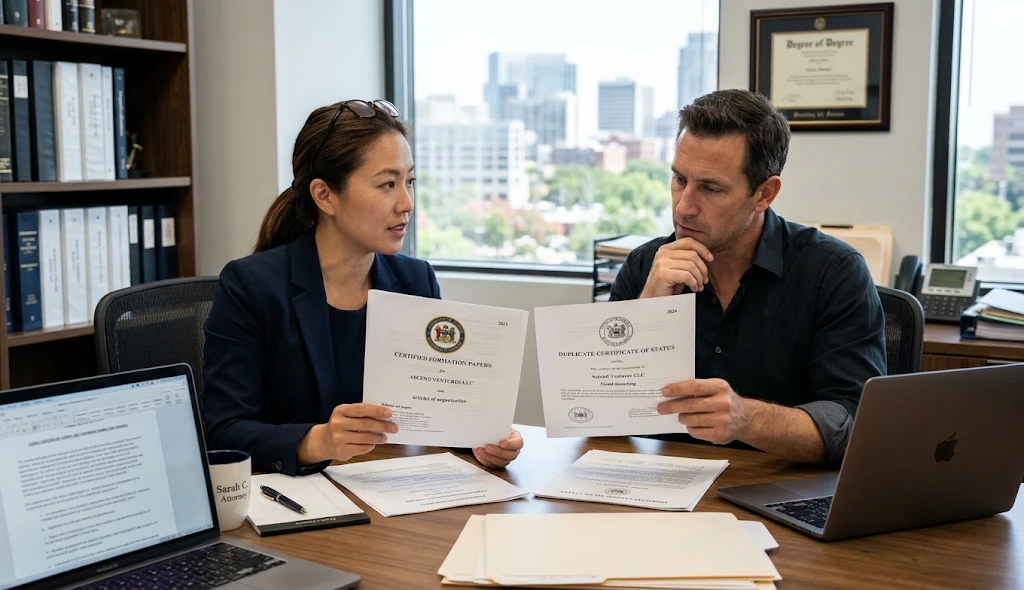
Foreign tax authorities enforce independent documentation requirements for non-resident companies operating within their borders. Tax offices demand physical, legalised corporate records to issue local tax identification numbers. Evaluating administrative obligations requires understanding when to obtain a Duplicate Certificate Vs Certified Formation Papers to meet specific jurisdictional requirements.
How Do Physical Corporate Records Protect Overseas Directors During Audits?
Physical corporate records protect overseas directors during audits by establishing an undisputed legal audit trail that satisfies foreign tax authorities, external auditors, and international compliance reviews. Physical records provide immediate, offline proof of corporate standing and corporate governance compliance.
Tax authorities in foreign jurisdictions regularly audit non-resident business owners to evaluate cross-border tax liabilities. Overseas directors must prove that their UK entity operates as a legally distinct corporate body. Maintaining physical certificates of incorporation alongside corporate registers proves the legal establishment date, initial capital structure, and original corporate registration details.
External auditors conducting international financial reviews mandate the inspection of original corporate records. Auditors verify corporate history by comparing financial statements against official paper documents issued by Companies House. Having immediate physical access to official incorporation documents eliminates audit delays and prevents compliance penalties.
Physical records protect corporate directors during international legal disputes or banking reviews. When online portals undergo maintenance or digital access becomes temporarily restricted, physical records provide uninterrupted verification of corporate status. Overseas founders maintain full operational continuity by storing physical corporate documents in secure company archives.
What Are the Risks of Relying Exclusively on Digital UK Filings?
Relying exclusively on digital UK filings risks sudden account freezes, rejected foreign licence applications, failed cross-border transactions, and severe administrative delays. Foreign counterparties and overseas banks frequently reject unverified digital downloads, creating operational bottlenecks for international businesses.
Overseas banks routinely conduct unannounced periodic reviews of non-resident corporate accounts. If a bank compliance officer requests physical corporate verification and the business owner cannot produce official paper records, the bank freezes corporate transactions. Unfreezing an international account requires sourcing official physical documents from the UK, causing costly operational downtime.
Foreign government agencies automatically reject digital PDF printouts during commercial licence applications. Non-resident entrepreneurs lose valuable market entry opportunities when local authorities demand paper documents issued directly by Companies House. Securing official paper records early prevents missed deadlines in international business expansions.
Cross-border payment gateways and merchant processors enforce strict document verification standards for non-UK directors. Merchant acquirers suspend payment processing privileges when digital uploads fail automated security checks. Presenting official, physical corporate certificates resolves merchant verification flags and maintains uninterrupted payment processing capabilities.
How Can Non-Resident Founders Efficiently Manage UK Document Requirements?
Non-resident founders efficiently manage UK document requirements by pairing digital filing efficiency with professional document procurement services. Partnering with specialised UK corporate service providers ensures international entrepreneurs receive physical corporate certificates alongside immediate digital registration credentials.
Managing UK corporate administration from abroad requires navigating distinct legal systems and international dispatch logistics. Overseas entrepreneurs must maintain accurate statutory records while securing official paper documents for international use. Working with dedicated corporate service specialists streamlines the acquisition of official physical certificates directly from Companies House.
Non-Resident UK Company Formation provides dedicated corporate administration and document procurement solutions designed specifically for international entrepreneurs. When founders form a UK company online, processing can take as little as 3 working hours once complete and accurate information is submitted and all necessary legal and ID checks are completed. Receiving official Web Filing Authentication Codes online alongside physical document delivery gives overseas founders full administrative control over their UK corporate structure.
Establishing a resilient cross-border business requires combining digital agility with physical compliance infrastructure. Non-resident entrepreneurs secure their international commercial operations by acquiring official physical corporate records to satisfy global banking, legal, and regulatory requirements.



0 comments
No comments yet — be the first to share your thoughts.