
Can You Remove Your Address From Companies House After It Is Published?
Learn whether you can remove your home address from Companies House after publication. Explore available options, privacy protections, and practical steps to help safeguard your personal information as a UK company director.
Yes, partly. Companies House removes director home addresses from the public register on application, but a registered office address stays public. Companies House also redacts historic documents case by case. Protecting your address at incorporation prevents publication from the start.
This answer covers the three address types on the register, the removal routes for each, and the limits of those routes. It is written for non-UK residents who plan to incorporate a UK limited company.
What addresses does Companies House publish?
Companies House publishes the registered office address, the director service address, and the correspondence address on filed documents. It holds the director's residential address privately. Every public filing stays searchable by anyone for free.
The Companies House register holds records for more than 5 million UK companies. Every record is open to the public through the online search service. Three address types matter for privacy.
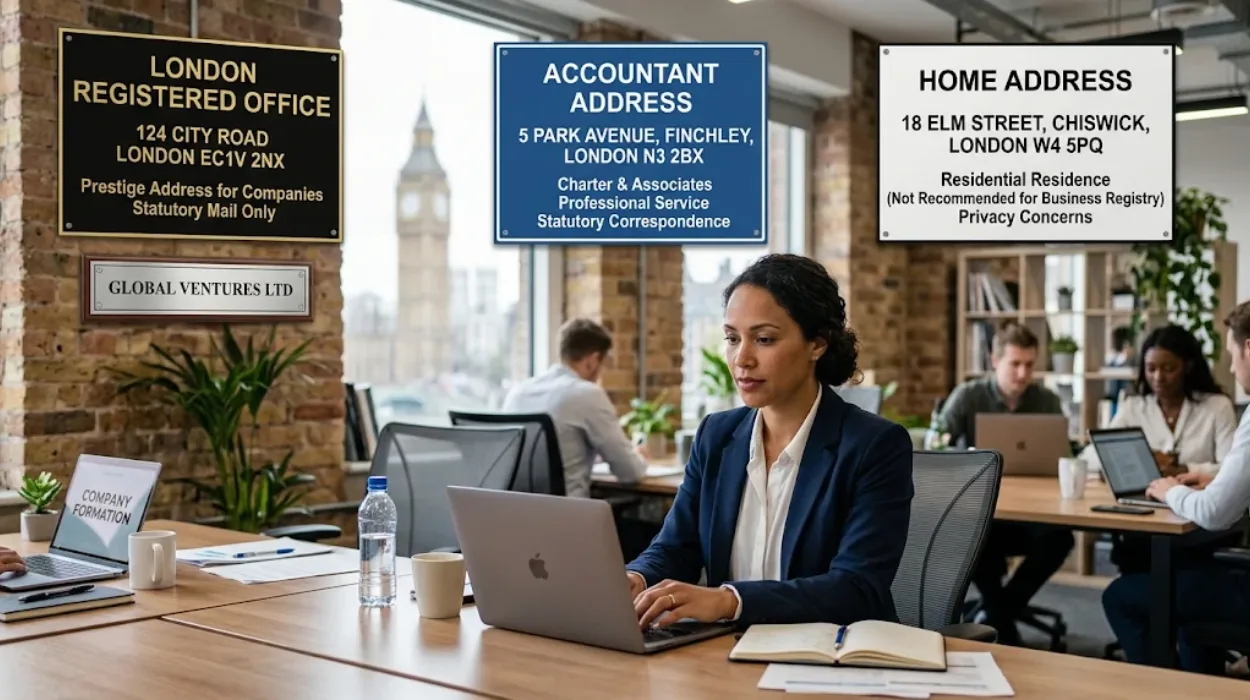
The registered office address is the official address for legal notices. It appears on the company profile, on the certificate of incorporation, and on every confirmation statement. The service address is the address a director lists for public records. It replaces the home address on the public register. The residential address is the director's home address. Companies House keeps it on a restricted record.
Public authorities and credit reference agencies can access that restricted record. The general public cannot. This protection applies only where the director has supplied a separate service address. A director who uses a home address as the service address publishes that address on the public register.
Can a director's home address be removed from the public register?
Yes. Directors apply to Companies House to remove a residential address from the public register. The Companies (Disclosure of Address) Regulations 2015 govern the process. Companies House then replaces the address with the service address on the public record.
Removal depends on where the address appears. A home address filed as a service address sits in documents on the public register. Those documents include appointment forms, confirmation statements, and annual accounts. Companies House can remove the address from those documents once the application is approved.
The Economic Crime and Corporate Transparency Act 2023 widened these rights from 2024. Directors, people with significant control, and other officers can now apply to remove certain personal information from the register. Applicants provide evidence that the address on the record is a residential address. They also identify each document that displays it.
Removal covers the public register only. Companies House keeps the address on its restricted record. Authorised bodies retain access to that record.
Can a registered office address be removed after publication?
No. A registered office address is a mandatory public record. A company changes it by filing a new address with Companies House. The previous address remains in the filing history as a historic record.
Companies House requires every company to maintain a registered office in the United Kingdom. The address must be appropriate. A person acting on behalf of the company must receive documents there. A PO Box does not qualify.
The company can update the address by filing a change of registered office. The filing takes effect once Companies House accepts it. The new address appears on the company profile. The old address stays in the filing history.
The exception covers residential addresses. A director who used a home address as the registered office can apply for removal of that address from the register. The application uses the same residential address route described above. A commercial address on the register has no removal route.
How does the address removal process work?
The applicant submits a written application with evidence to Companies House. Companies House reviews the application, removes the address from listed documents, and confirms the outcome. Removal applies to the public register only.
The process has three stages: identification, evidence, and review.
Identification comes first. The applicant lists every document that shows the address. Companies House provides a search tool for the filing history. Each document carries a date, a form type, and a description.
Evidence follows. The applicant shows that the address is residential. Companies House checks the application against its own records. Incomplete applications cause delays. A missing document reference is the most common cause.
Review is the final stage. Companies House decides whether to approve the application. Approved applications lead to the removal of the address from the listed documents. The address also disappears from the public search results.
Copies already downloaded cannot be recalled. Third-party data aggregators scrape the register continuously. Scraped copies of published addresses can persist on commercial websites. Companies House has no authority over those copies. Removal after publication therefore reduces exposure but does not reverse it.
Why does protecting your address at formation work better than removing it later?
Protection at formation stops the address from reaching the public register at all. A removal application only reduces exposure after publication. Formation-stage privacy avoids the application stage, the review period, and any third-party copying.
Companies House publishes new company details when it registers the company. The register becomes searchable immediately. Data aggregators collect new filings within days. An address filed incorrectly at incorporation can reach several external databases before any removal application is approved.
Formation-stage protection works through three choices. The company uses a UK registered office address supplied by a provider. Each director lists a service address instead of a home address. The residential address goes to the restricted record only. These choices keep the home address off the public register from the first filing.
The Non-Resident Privacy Shield applies this approach at incorporation. It supplies a UK registered office address and a director service address. The company files with those addresses from day one. The package is built for directors who live outside the United Kingdom. The Non-Resident Privacy Shield keeps personal addresses off the public register at the point of registration.
Formation speed also matters. A company can be formed online in as little as 3 working hours. That timeframe applies when the information is complete and accurate. All legal and identity checks must also be complete. Processing times depend on Companies House and exclude weekends and bank holidays.
Delays occur when information or documents are incomplete or incorrect. Technical or application complexities can add processing time. The Web Filing Authentication Code appears online on the company summary page once the company is registered. Directors use that code to file future updates directly with Companies House.
How do the two approaches differ for non-UK residents?
Formation-stage protection prevents publication. Later suppression removes an address after publication. Both routes work, but only one avoids the exposure period. The comparison matters most for directors who live abroad.
Non-UK residents face a specific risk. A foreign home address on the UK register is searchable worldwide. That address can appear in search engine results and in business-intelligence databases. Foreign directors often lack a UK address, so the home address is the default entry on forms.
The two approaches differ on four points: timing, effort, scope, and certainty. Formation-stage protection operates before publication. Suppression operates after publication. Formation-stage protection needs no review. Suppression needs Companies House approval. Formation-stage protection covers the first filing. Suppression covers only the documents listed in the application.
The comparison between the two routes has its own detailed treatment. The guide on protecting your address at formation versus applying to suppress it later sets out each option against specific criteria. The guide helps directors evaluate which route fits their situation.
What does this mean for UK company directors who live abroad?
A published address can be partly removed, but never fully recalled. Directors who live abroad protect their privacy best by choosing formation-stage address protection. Non-Resident UK Company Formation delivers that protection through the Non-Resident Privacy Shield.
Three facts summarise the position. Companies House removes residential addresses from the public register on application. A commercial registered office address stays public, and the filing history keeps every earlier address. Third-party copies fall outside Companies House control.
These facts make the formation stage the strongest point of protection. Directors who choose a registered office address and a service address at incorporation avoid the application process entirely. The home address stays on the restricted record, accessible only to authorised bodies.
Non-Resident UK Company Formation serves non-UK residents exclusively. Its Non-Resident Privacy Shield supplies the addresses that keep personal details off the public register. Directors who start with the right addresses have no published address to remove. Directors who already have a published address have a clear route through the Companies House application.



0 comments
No comments yet — be the first to share your thoughts.