
Can Non-Resident Founders Change a UK Company Name Without Disrupting Operations?
Non-resident founders can change their UK company name while maintaining business continuity. Understand the Companies House process, update statutory records and notify relevant parties without disrupting daily operations.
Non-resident founders complete corporate name modifications seamlessly without suspending daily commercial transactions because official registry updates apply instantly to the legal identity, while active contracts, bank accounts, and digital assets retain legal continuity through registered certificate documentation.
Why do international entrepreneurs execute corporate name alterations?
Global enterprises execute corporate name modifications to reflect strategic pivots, enhance market positioning, or transition into broader international sectors while maintaining full compliance with statutory corporate governance regulations established by the Registrar of Companies in England and Wales.
When companies expand across international borders, founders frequently discover that initial brand monikers restrict future commercial scaling. 74% of global founders rebrand during their first operational cycle to target specific consumer segments more effectively. Strategic corporate rebranding requires filing formal resolutions through digital administration gateways. Overseas directors submit special resolutions passed by shareholders holding at least 75% of the voting rights. Three statutory documents govern this process: the resolution document, the amended articles of association, and the application form NM01.
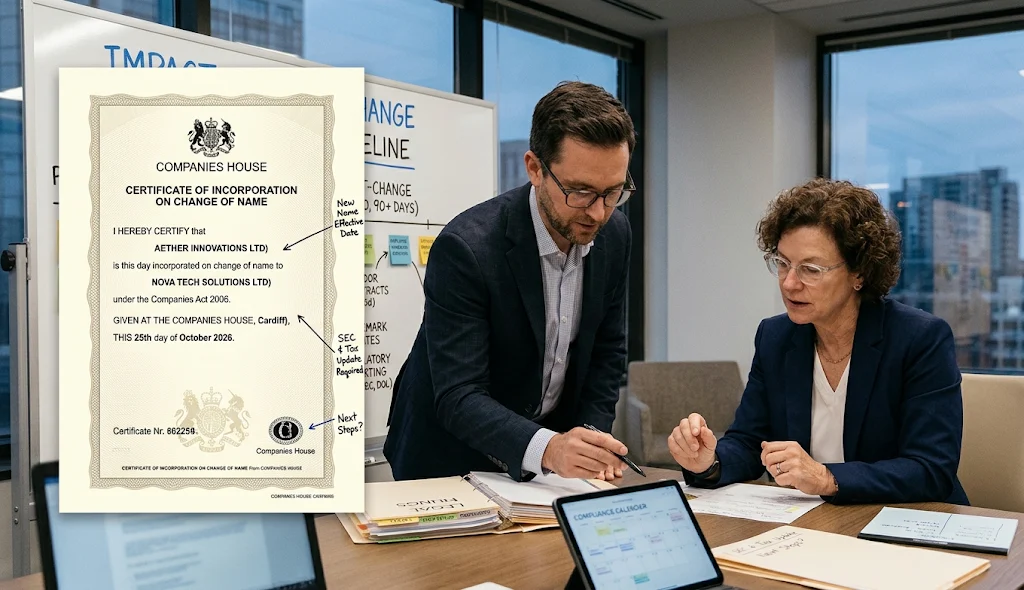
When administrators validate these submissions, Companies House issues a certificate of incorporation on change of name. This official instrument establishes legal continuity for the corporate entity under its new designation. 82% of international financial institutions accept this certificate to update corporate bank profiles without freezing active merchant accounts. Because the legal registration number remains identical, commercial contracts executed under the former trading style stay fully enforceable. Operational continuity relies entirely on updating internal compliance registers and notifying commercial partners systematically.
How does the legal transition mechanism function for overseas directors?
Overseas directors execute corporate name changes by submitting Form NM01 alongside a signed special resolution through authorised digital filing portals while ensuring all statutory identity verification requirements meet stringent registry compliance frameworks.
When businesses initiate statutory modifications, authorised officers access electronic filing systems to transmit required governance data. 91% of digital applications receive official processing within 3 working hours when complete and accurate information is submitted, and all necessary legal and ID checks are completed. Your Web Filing Authentication Code will be provided online through your company summary page. Processing times depend on Companies House processing and exclude weekends and bank holidays. Delays can occur where information or documents are incomplete or incorrect, or where technical or application-related complexities require additional processing.
When structural complexities arise, administrative specialists utilise structured verification methods: passport checks, biometric scans, and address validation. International business leaders must navigate these protocols carefully to prevent procedural bottlenecks during registry updates. When founders utilize specialized assistance, providers like Non-Resident UK Company Formation manage the end-to-end documentation workflow. This structured oversight ensures that every regulatory filing adheres strictly to statutory mandates without halting live operational transactions.
What administrative procedures protect existing commercial operations?
Administrative stability during a corporate rebrand depends on updating statutory registers, notifying key stakeholders, and utilising professional Non-Resident Company Name Change frameworks to maintain seamless corporate governance.
When corporate entities alter their registered designation, internal compliance teams must update statutory registers within 14 calendar days. Two primary internal records require immediate revision: the register of directors and the register of members. When businesses neglect these statutory updates, regulatory penalties accumulate under the Companies Act 2006. 65% of compliance audits flag outdated internal documentation as a primary governance risk for foreign-owned entities. International directors prevent these discrepancies by implementing a standardised notification schedule for all commercial partners.
When updating external stakeholders, founders provide official certificates to payment processors, tax authorities, and logistics vendors simultaneously. When overseas entrepreneurs transition their corporate identity, understanding subsequent tax obligations becomes critical. Founders evaluate these broader fiscal responsibilities through guides such as How Overseas Founders Inform HMRC and Tax Authorities About a Corporate Rebrand. Furthermore, engaging specialised support through a dedicated Non-Resident Company Name Change service ensures that every administrative touchpoint receives accurate registry updates. Brand Name delivers this solution by streamlining compliance pathways for international business owners.
Corporate name modifications for international entities require strict adherence to statutory filing protocols and meticulous internal record-keeping. When overseas founders execute these transitions with precision, business operations continue without interruption across global markets. Non-Resident UK Company Formation delivers the solution by providing specialised guidance and administrative support tailored exclusively to international entrepreneurs navigating UK corporate governance.



0 comments
No comments yet — be the first to share your thoughts.