
How Overseas Founders Inform HMRC and Tax Authorities About a Corporate Rebrand
Learn how overseas founders notify HMRC and relevant tax authorities about a UK corporate rebrand. Understand the required updates, tax records and compliance steps to maintain accurate business information and avoid delays.
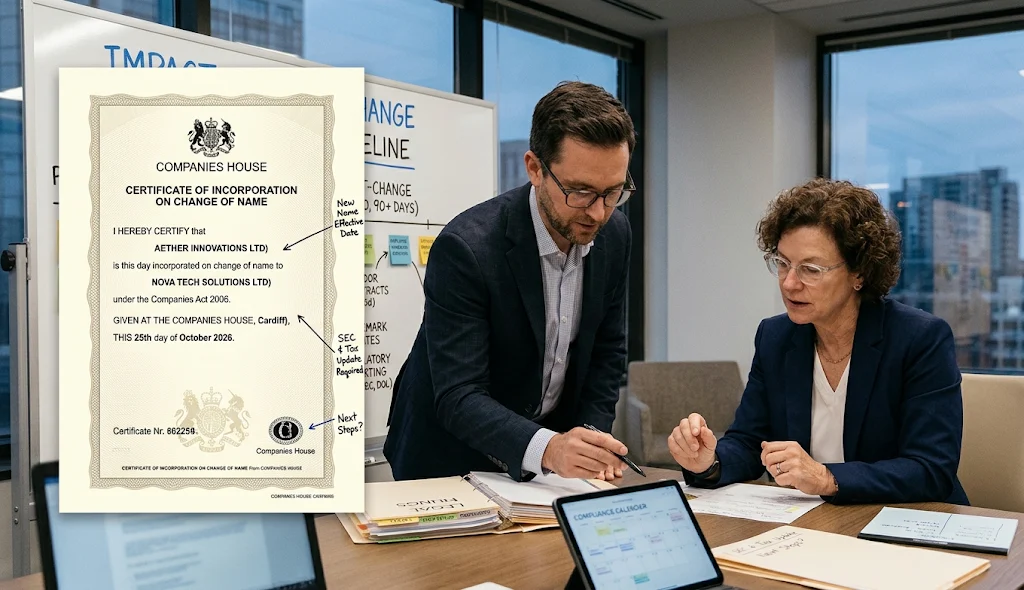
Overseas founders inform HMRC of a corporate rebrand by updating their official records through the HMRC digital tax service or business tax account within 30 days of the Registrar of Companies issuing the new certificate.
When Must International Directors Update HMRC After a Corporate Name Change?
International directors must update HMRC within 30 days of Companies House issuing the new certificate of incorporation on change of name.
HMRC requires timely notification because corporate tax records, Pay As You Earn schemes, and Value Added Tax registrations link directly to the registered company name. When companies complete a formal identity transition, updating tax databases prevents communication failures between regulatory bodies. Non-resident business owners manage this update through government gateway portals or by submitting written notices to their assigned corporation tax office.
Corporate governance frameworks mandate that accurate statutory details remain visible across all official tax correspondence. HMRC systems synchronise with Companies House registries to verify legal entity amendments. Tax agents appointed by international firms submit administrative updates using authorised digital channels. Timely updates protect organisations from compliance penalties and maintain uninterrupted fiscal operations.
Which Tax Accounts Require Immediate Amendment During a Rebrand?
Corporate tax accounts, VAT registrations, and employer PAYE schemes require immediate amendment when a company alters its official legal designation.
Corporation tax profiles hold the unique taxpayer reference assigned to the corporate entity at incorporation. When the official name shifts, automated validation checks flag discrepancies if tax returns display a title that differs from the Companies House register. Value Added Tax systems require identical alignment to ensure input tax recovery remains valid for international trade transactions. Employer PAYE schemes need prompt modification because payroll submissions require matching employer identifiers to process real-time information accurately.
Designated officers log into individual tax dashboards using secure government gateway credentials. Administrators select the profile management section to input the updated corporate title. Digital assistants validate the new registration number against public registry data feeds. Automated verification protocols complete the update cycle within 3 business days, issuing electronic confirmation notices to the primary administrative contact.
How Does Non-Resident UK Company Formation Support Global Businesses Through Rebranding?
Non-Resident UK Company Formation provides specialised administration services to assist international founders with statutory filings and regulatory compliance updates.
Managing corporate administrative tasks across international borders involves navigating complex statutory requirements set by UK authorities. Our team delivers a structured pathway for businesses executing a Non-Resident Company Name Change to secure legal compliance without operational friction. We ensure that every administrative filing reflects accurate registry data before submission to relevant government departments.
International entrepreneurs benefit from expert guidance on statutory record-keeping and corporate governance standards. Understanding these obligations helps foreign directors maintain good standing with regulatory institutions. For deeper insights into pre-rebrand considerations, read our guide on Can Non-Resident Founders Change a UK Company Name Without Disrupting Operations?. Evaluating these operational impacts ensures seamless transitions for global enterprises.
What Documentation Do Tax Authorities Require to Process a Name Update?
Tax authorities require the new certificate of incorporation, board resolution documents, and updated statutory registers to process a corporate name update.
Official verification demands physical or digital copies of the certificate issued by the Registrar of Companies. Board resolutions prove that shareholders authorised the title modification in accordance with the articles of association. Updated statutory registers demonstrate that internal corporate governance records match external public registries. Tax compliance officers review these documents to authenticate the legitimacy of the restructuring event.
Submitting incomplete or incorrect documentation triggers administrative delays that stall tax account updates. Three verification documents are necessary: the certificate of incorporation on change of name, the updated memorandum of association, and proof of registered office address. Compliance teams upload these files through secure portal interfaces provided by government revenue departments. Digital receipt notifications confirm successful document transmission for audit trails.
How Do Global Enterprises Update Third-Party Financial Systems After Notification?
Global enterprises update banking institutions, merchant processors, and payment gateways immediately after receiving confirmation from tax authorities.
Commercial banking partners require official confirmation from both Companies House and HMRC before modifying account titles. Merchant processors inspect updated tax certificates to verify compliance with international anti-money laundering regulations. Payment gateways mandate synchronised records to prevent transaction processing failures caused by mismatched corporate identifiers. Maintaining accurate data across all financial touchpoints protects corporate assets and sustains commercial credibility.
Compliance officers submit updated corporate credentials directly to institutional relationship managers. Financial institutions conduct internal verification checks against public registries to validate the amendments. Two security protocols govern this process: cryptographic digital signature verification and authorised director identity confirmation. Completing these security checks re-establishes full operational capacity across all commercial banking channels.
What Are the Compliance Risks of Failing to Notify HMRC Promptly?
Failing to notify HMRC promptly creates severe compliance risks, including financial penalties, frozen tax accounts, and potential legal audits.
Delayed notifications disrupt the flow of official correspondence regarding corporate tax liabilities and statutory filing deadlines. Revenue authorities issue compliance checks when tax return identifiers fail to match active public registry entries. Unresolved discrepancies trigger automatic penalties that accumulate interest over predetermined statutory periods. Protecting organisational interests requires strict adherence to notification timelines established by regulatory bodies.
Tax compliance frameworks enforce strict accountability for corporate directors regardless of their geographic location. Professional advisory services help mitigate these risks by managing statutory notifications with precision. For detailed instructions on analysing your new corporate credentials after administrative completion, review our analysis on Decoding Your Official Certificate of Incorporation on Change of Name from Companies House. Maintaining absolute clarity over corporate documentation safeguards international business operations.
Navigating the tax and regulatory implications of a corporate rebrand demands meticulous attention to statutory deadlines and documentation standards. Non-Resident UK Company Formation delivers targeted administrative solutions designed exclusively for international entrepreneurs seeking seamless corporate management. Our expertise ensures that every regulatory update reaches HMRC and associated authorities accurately, protecting your enterprise from compliance disruptions.



0 comments
No comments yet — be the first to share your thoughts.