
How Do Companies House Public Registers Differ From Your Private Legal Certificates?
Understand the key differences between Companies House public registers and private legal certificates, including which company details are publicly accessible and which documents remain confidential for your UK business.
Companies House public registers provide live online data for transparency, while your private legal certificates act as permanent offline proof of legal ownership and incorporation. Public register entries update dynamically, whereas private certificates remain static historical documents issued at specific legal events.
What Is the Main Legal Purpose of the Public Register?
The primary legal purpose of the Companies House public register is ensuring corporate transparency by displaying real-time statutory information to the public. It allows lenders, clients, and enforcement agencies to verify active company status, officer details, and legal compliance history online instantly.
Companies House maintains the public register as an open database for corporate accountability. UK legislation requires every registered entity to file annual confirmation statements, statutory accounts, and immediate updates regarding directorship changes. The public register acts as an official record for third-party verification. Prospective investors and commercial partners examine these public entries to evaluate corporate standing before signing contracts.
Dynamic updates mean the public register reflects current operational realities. When directorships change, or registered office addresses move, the online register updates to show these legal adjustments. Legal notices, mortgages, and insolvency proceedings are also published directly on the public file. This public accessibility protects commercial interests across international borders by allowing instant due diligence.
Overseas business owners must maintain complete alignment between operational reality and public filings. Inaccuracies on the public register can trigger legal penalties or compliance warnings from UK regulators. The public register serves as the authoritative source for official notices, legal service of process, and public scrutiny.
How Do Private Legal Certificates Function for a UK Company?
Private legal certificates function as definitive, static physical proof of specific legal milestones and ownership structures. They prove official company formation, legal share issuance, and internal administrative authority during corporate transactions, banking applications, and legal audits.
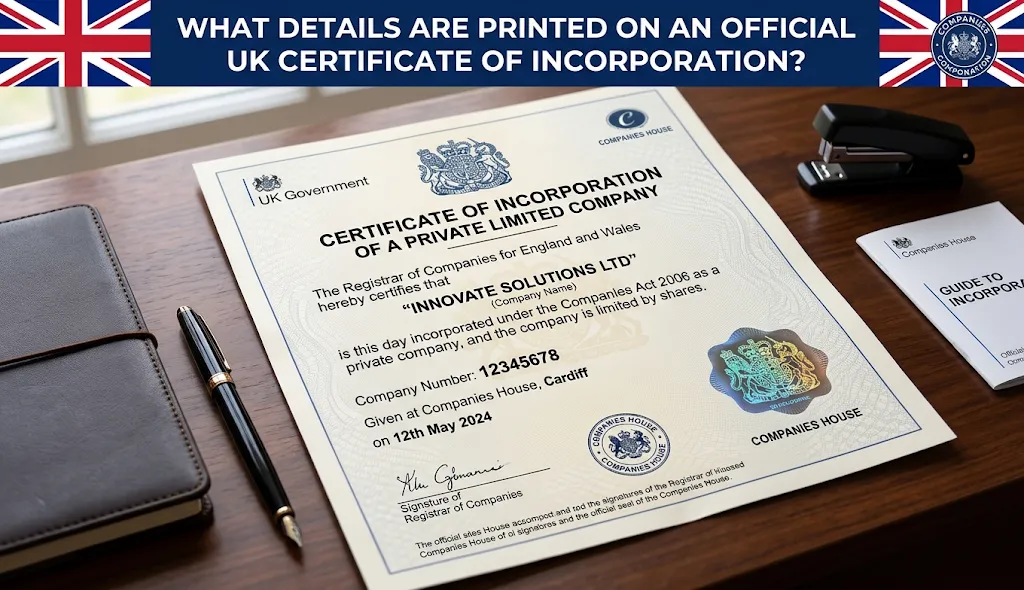
Private legal certificates include your official Certificate of Incorporation, share certificates, and statutory registers. The registrar issues the Certificate of Incorporation upon successful registration, detailing your unique company number, official name, and date of formation. Unlike public digital entries, private certificates remain unchanged over time as historical evidence of legal establishment.
Bank account providers and financial institutions require original or certified copies of private legal certificates to open accounts. Shareholders hold physical share certificates as legal title to their equity within the business entity. Directors maintain private statutory registers at the registered office to document internal governance decisions accurately.
Losing these foundational documents disrupts formal corporate proceedings and international compliance checks. If you misplace your original founding paperwork, requesting a Duplicate Certificate of Incorporation ensures you retain verified proof of company formation for institutional verification. Non-Resident UK Company Formation supplies official replacements directly to non-UK residents needing valid governance files.
Why Does Public Register Data Change While Certificates Remain Static?
Public register data changes to reflect ongoing statutory updates and corporate alterations over time. Legal certificates remain static because they record snapshot data confirming specific legal events, such as the initial incorporation date or explicit share issuance, on precise dates.
Corporate entities experience continuous changes throughout their operational lifecycles. Directors resign, registered addresses move, and share capital alters through new issuances. Companies House updates the public database whenever officers submit compliance filings. Consequently, the public register represents a fluid, live snapshot of present corporate status.
Conversely, physical certificates act as historic legal deeds. A Certificate of Incorporation records the exact moment legally recognised entity creation occurs. The document date never changes, regardless of subsequent name changes or operational restructuring. Subsequent corporate name changes generate distinct certificates of name change, preserving the original incorporation certificate intact.
This distinction prevents corporate confusion during international legal reviews. Cross-border regulators inspect original certificates to establish corporate origins while checking public databases to verify active status. Both document types work together to confirm complete legal legitimacy across international jurisdictions.
Which Details Are Displayed Publicly on Companies House Registers?
Public registers display director names, correspondence addresses, nationality, occupation, control structures, registered office locations, filing history, accounts, and confirmation statements. The register makes this statutory information freely accessible to global public users online.
The UK corporate framework mandates public visibility for key operational details to prevent fraudulent trading. Every active limited company exposes its official officers list, including directors and company secretaries. Persons with Significant Control (PSCs) must also register their beneficial ownership details publicly to show who the ultimate decision-makers are.
Statutory filing histories appear chronologically on the public profile. Anyone can view submitted annual accounts, balance sheets, capital statements, and filed confirmation statements. Public records show historical changes to the company name, former registered office addresses, and previous officer resignations.
Public visibility requires careful administrative handling by non-resident directors. Using personal residential addresses for public filings exposes private living details globally. Officers frequently utilise professional service addresses to protect personal privacy on the public register while fulfilling legal transparency mandates completely.
Which Governance Documents Remain Exclusively Private to the Company?
Private governance documents include internal board meeting minutes, written director resolutions, detailed registers of members, initial subscriber agreements, and physical share certificates. These documents remain privately stored within company archives rather than published online.
Internal governance documents record detailed operational decisions, board discussions, and private commercial agreements. Board meeting minutes capture strategic planning, contract approvals, and internal management decisions. These internal records remain strictly confidential between directors and legal owners unless requested during court proceedings or official tax audits.
The private register of members serves as the legal proof of share ownership under UK company law. While public records disclose main shareholder lists during annual filings, the internal share register determines legal membership rights. Directors must keep these private registers up to date at the registered office address.
Understanding these governance layers helps non-resident business owners manage compliance risks effectively. Reading about what details are printed on an official UK Certificate of Incorporation clarifies how initial formation data translates into long-term statutory paperwork. Non-Resident UK Company Formation assists overseas directors in organising private company registers correctly.
How Do Financial Institutions Verify Public Data Against Private Documents?
Financial institutions verify corporate entities by cross-referencing public Companies House data with private certificates and identity records. They compare public active status against private share certificates to validate legitimate ownership structures before opening accounts.
Banks and payment processors execute rigorous Know Your Customer (KYC) checks on non-resident companies. Compliance officers check the public register to confirm the company possesses active, solvent status. They ensure filed annual accounts are up to date and verify that reported directors match bank applicant identity records.
Next, financial institutions demand physical or certified copies of private certificates. They require the Certificate of Incorporation to verify legal entity creation. They inspect private share certificates and internal member registers to trace ultimate beneficial ownership structures directly to individual non-resident applicants.
Discrepancies between public filings and private documents cause immediate banking rejections. If a public confirmation statement lists different share counts than private share certificates, compliance systems flag the application. Non-resident entrepreneurs must synchronise public filings with private documentation before approaching corporate financial providers.
What Steps Resolve Discrepancies Between Public Records and Private Certificates?
Resolving discrepancies requires filing corrective statutory forms with Companies House or updating internal private registers promptly. Directors submit formal administrative amendments online or issue amended private certificates to align all official records accurately.
Discrepancies arise when directors alter internal company structures without submitting corresponding Companies House filings. For example, issuing new shares internally without filing capital updates creates legal conflicts. Directors must identify whether the error exists in the public filing or the internal administrative register.
To correct public register errors, officers submit corrective statutory forms directly to Companies House. Filing an amended confirmation statement or updating officer details rectifies public records. If private registers contain errors, directors update internal books and re-issue accurate share certificates to affected shareholders.
Ensuring complete document alignment protects your business during corporate acquisitions or audits. Reviewing transparent pricing and VAT inclusions for non-resident document replacements enables international business owners to replace missing certificates without administrative delays. Non-Resident UK Company Formation provides full support to correct administrative mismatches efficiently.
How Does Non-Resident UK Company Formation Support Overseas Directors?
Non-Resident UK Company Formation delivers tailored administrative services, document procurement, and compliance management for international entrepreneurs. They handle official filings, replace legal documentation, and maintain regulatory alignment with Companies House requirements seamlessly.
Operating a UK company from abroad introduces distinct administrative and regulatory challenges. Non-resident directors must navigate strict UK compliance schedules while managing international time zone differences. Non-Resident UK Company Formation structures its business services specifically around the requirements faced by non-UK residents.
The service provides direct assistance with initial online incorporation, statutory address provision, and ongoing secretarial administration. When overseas companies face lost paperwork or banking audits, Non-Resident UK Company Formation retrieves official duplicate certificates quickly. This support ensures non-resident entrepreneurs preserve operational continuity without traveling to the United Kingdom.
By managing both public compliance filings and private documentation needs, Non-Resident UK Company Formation safeguards your UK entity. Overseas owners receive professional guidance to fulfill legal obligations, maintain corporate privacy, and secure essential business records reliably.



0 comments
No comments yet — be the first to share your thoughts.