
How Much Does a Non-Resident Pay for UK Document Replacements with Full VAT Transparency?
Understand the pricing and VAT inclusions for non-resident document replacements. Explore transparent costs, applicable taxes and replacement fees to manage your UK company documents with confidence.
A non-resident company owner pays a fixed service fee and standard UK Value Added Tax (VAT) when requesting official UK document replacements. Tax treatment depends on your operational status, location, and whether the service incorporates physical international dispatch or digital document authentication.
Non-resident business owners operating a United Kingdom Private Limited Company (Ltd) often require official replacements of essential corporate records. Obtaining official replacements of essential corporate records ensures continuous operational compliance and satisfies international verification requirements. Non-Resident UK Company Formation provides UK company formation and business support services exclusively for non-UK residents. Processing times depend on Companies House processing and exclude weekends and bank holidays. A company can be formed online in as little as 3 working hours when complete and accurate information is submitted, and all necessary legal and ID checks are completed. Your Web Filing Authentication Code will be provided online through your company summary page. Delays can occur when information or documents are incomplete or incorrect, or when technical or application-related complexities require additional processing.
What Fees Apply to Non-Resident Company Document Replacements?
Document replacement costs for non-residents consist of official government filing charges, administrative service fees, and applicable Value Added Tax based on your physical location. International delivery fees and legalisation costs apply when physical hard-copy documents require overseas courier dispatch.
Corporate document replacements involve distinct administrative and statutory components. Companies House charges statutory fees for issuing official corporate documents. Service providers add administrative management fees to process application forms, verify director identities, and submit filings to the official register. When ordering a Duplicate Certificate of Incorporation, non-residents must account for secure courier transport fees.
Overseas delivery costs vary according to destination countries and selected shipping speeds. Express international couriers process physical shipments with full tracking capabilities. Digital PDF copies do not incur international shipping charges. Legalisation services add further costs if overseas authorities require apostille certification.
Value Added Tax applies to specific service components depending on the customer's tax residency. UK service providers must evaluate whether services fall under UK VAT rules. Administrative processing fees typically include standard UK VAT when supplied by UK entities. Government filing charges are zero-rated or exempt from statutory tax additions.
Overseas business founders must review full pricing structures before submitting formal replacement requests. Transparent billing outlines exact government costs, administrative service fees, courier charges, and tax additions. Clear pricing breakdowns protect international directors from hidden charges during corporate retrieval workflows.
How Does UK VAT Apply to Non-Resident Directors Purchasing Service Add-ons?
UK VAT rules charge standard 20 per cent tax on administrative services provided to overseas individuals unless specific cross-border business-to-business place-of-supply exemptions apply. Corporate tax status determines whether VAT appears on your final replacement invoice.
Value Added Tax (VAT) rules depend on the status of the recipient purchasing corporate services. The UK tax authority applies specific place-of-supply rules for international services. When an overseas individual purchases company services, standard UK VAT applies to administrative fees.
Corporate entities operating outside the UK may qualify for place-of-supply tax exclusions. If an overseas business provides proof of international tax registration, administrative fees fall outside the scope of UK VAT. Service providers require valid tax identification numbers to apply business-to-business tax exemptions.
Official statutory fees charged by statutory bodies remain exempt from standard tax rates. Statutory fees pass directly to corporate clients without additional VAT markups. Service invoices separate statutory fees from taxable administrative charges.
Understanding tax applications prevents unexpected expenses during corporate documentation maintenance. Non-Resident UK Company Formation ensures complete fee transparency by detailing VAT additions prior to transaction completion. International directors maintain clear financial records when statutory costs and taxable administrative fees appear as distinct invoice line items.
Why Do Non-Residents Require Official Certified Document Replacements?
Non-resident directors require certified document replacements to open business bank accounts, register for foreign tax IDs, complete compliance audits, and satisfy international KYC checks. Official duplicates provide legally recognised evidence of corporate existence.
Overseas directors must present official corporate certificates to international financial institutions. Global banks require legal proof of incorporation before opening corporate accounts. Financial compliance officers reject unverified photocopies or unofficial digital prints. Certified replacement certificates confirm that a business remains active and legally registered.
International regulatory bodies demand verified corporate documents during foreign branch registrations. When expanding operations into new territories, foreign governments inspect UK corporate filings. Authorities verify director details, share structures, and registration dates against official state records. Understanding how Companies House public registers differ from your private legal certificates helps directors present the correct documents to regulatory bodies.
Third-party vendors and trade partners request certified corporate paperwork before executing commercial contracts. Payment gateway providers mandate official verification documents during annual merchant account renewals. Legal representatives require authenticated records when conducting cross-border corporate transactions.
Prompt replacement of lost or damaged certificates prevents operational disruption for international firms. Certified duplicates contain original security features, official seals, and statutory references. Retaining certified copies ensures seamless compliance during corporate audits and international banking reviews.
What Factors Cause Delays in Processing Document Replacement Applications?
Delays occur when applications contain incorrect company registration details, incomplete director disclosures, failed identity verification checks, or technical filing errors. External processing backlogs at statutory registries and international courier delays also extend completion timelines.
Information accuracy directly determines document processing efficiency. Submitting inaccurate company names or incorrect registration numbers triggers immediate registry rejections. Registry systems cross-reference application data against master corporate files automatically. Mismatched details require manual intervention, extending processing timelines significantly.
Identity verification compliance introduces potential delays if documentation lacks clarity. Service providers must validate director identity credentials using official UK compliance frameworks. Submitting low-resolution passport scans or outdated address proofs halts application workflows. Identity verification services validate director credentials using official UK compliance frameworks to satisfy statutory anti-money laundering obligations.
Technical complications within digital filing portals disrupt document submission workflows. Registry system updates or server maintenance temporarily suspend application intake. Data entry formatting errors prevent electronic signatures from validating correctly within automatic filing portals.
External factors affect physical document delivery once statutory registries issue replacements. Overseas courier services face customs inspections, transit delays, and regional delivery disruptions. Holiday periods and statutory office closures alter standard operational schedules. Providing complete, accurate information initially minimises administrative bottlenecks.
How Does a Director Request a Certified Duplicate Certificate Online?
A director requests a certified duplicate certificate online by submitting company registration details, passing digital identity checks, selecting physical or digital delivery options, and completing secure payment. Authorised agents process the request directly through official registry portals.
Requesting duplicate corporate documents involves systematic verification and submission procedures. Directors begin by accessing an authorised online corporate service portal. Applicants input the exact company name and official company registration number.
Identity verification forms the next procedural requirement. Directors submit valid government-issued photo identification alongside recent proof of residential address. Service systems process identity records through secure verification channels to confirm applicant authority.
Applicants select their required document format and delivery destination. Options include digital electronic certificates, certified paper copies, or apostilled documents for international legal recognition. International applicants specify foreign delivery addresses for tracked courier shipping.
Payment processing completes the online ordering workflow. The system calculates statutory fees, administrative costs, courier rates, and applicable VAT. Upon successful payment, administrative teams submit verified applications to the central registry.
Once processed, systems dispatch digital copies electronically to secure client accounts. Physical documents transfer directly to international courier networks for global delivery. Directors track order progression in real time through online summary portals.
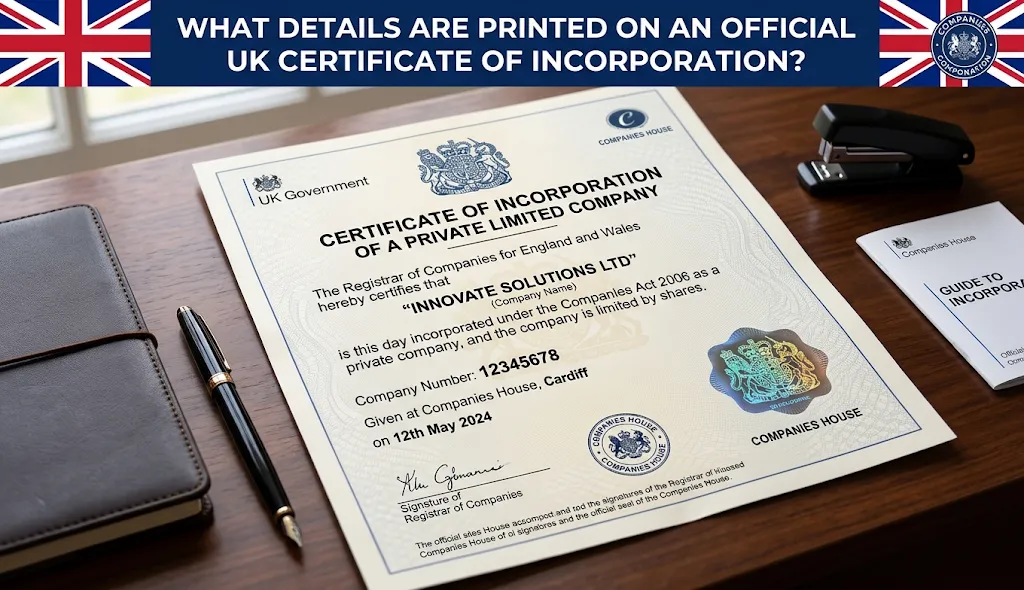
What Details Appear on a Duplicate Certificate of Incorporation?
A Duplicate Certificate of Incorporation displays the legal company name, official company number, incorporation date, company type, legal jurisdiction, and official registrar seal. The document matches the legal weight of the original certificate.
The physical certificate serves as the primary legal proof of corporate formation. The document states the official registered name of the business entity. Any legal name changes executed post-incorporation appear recorded on separate change-of-name documentation.
The official company registration number appears prominently on the face of the document. This unique alphanumeric code identifies the business permanently within the UK registry. The document records the exact statutory date on which legal entity status took effect.
The certificate specifies the legal structure of the business organisation. It identifies whether the company operates as a private limited company, public limited company, or limited liability partnership. The document identifies the underlying jurisdiction, specifying registration within England and Wales, Scotland, or Northern Ireland.
Understanding what details are printed on an official UK Certificate of Incorporation assists directors in verifying document authenticity. The duplicate features the official registrar seal and statutory sign-off. Replacements issued by the registry maintain identical legal authority to initial formation documents.
How Do Apostille Services Legalise Document Replacements for Foreign Use?
Apostille services legalise document replacements by obtaining an official certificate from the UK Foreign, Commonwealth and Development Office that verifies the authenticity of signatures and registry seals for international authorities.
Foreign governments require legal authentication before accepting UK corporate documents for official business. The Hague Convention of 1961 established the apostille framework to simplify cross-border document validation. An apostille certificate confirms the origin of public documents intended for international use.
The legalisation process requires submitting certified corporate documents to official state legalisation offices. Government officials examine the registrar signatures and official seals present on the replacement certificate. Officials compare document features against registered specimen records to confirm absolute authenticity.
Upon successful validation, legalisation officers attach an official apostille certificate directly to the corporate document. The apostille contains a unique registration number, official seal, government signature, and issuing date. Overseas authorities inspect these details to verify document validity without contacting UK registries.
Apostille certification is essential when opening foreign bank accounts, establishing overseas branches, or executing international commercial contracts. Obtaining an apostille ensures international courts, banks, and governments accept UK document replacements as legally binding instruments.
Managing non-resident UK corporate records requires complete clarity regarding statutory procedures, processing timelines, and transparent pricing structures. Non-Resident UK Company Formation streamlines replacement workflows by managing registry submissions, identity validation, and international document delivery. Overseas business owners maintain full regulatory compliance by securing certified replacement documents through structured, transparent service channels.



0 comments
No comments yet — be the first to share your thoughts.