
What Is the Difference Between Digital Copies and Printed Legal Copies of Company Documents?
Understand the key differences between digital and printed legal copies of company documents, including their uses, accessibility, legal validity and when UK businesses need each format.
A digital copy is an electronic file, such as a PDF, available through Companies House. A printed legal copy is a certified paper document. Digital copies support daily administration. Printed legal copies satisfy banks, foreign authorities, and courts that require certified proof.
What Is a Digital Copy of a Company Document?
A digital copy is an electronic version of a company document, stored as a PDF or similar file. Companies House issues digital copies at incorporation and publishes filed documents on the public register, where directors download them at any time.
A UK limited company generates three core documents at formation: the certificate of incorporation, the memorandum of association, and the articles of association. Companies House issues all three electronically for online applications. The company receives them as downloadable files.
Digital copies carry no wet-ink signature or embossed seal. They display the company name, company number, and incorporation date. Anyone with the company number retrieves the same record from the public register.
Digital copies suit routine tasks. Directors attach them to online bank applications, payment processor registrations, and supplier onboarding forms. Delivery is immediate, and duplication costs nothing in time or postage.
The limitation is acceptance. A digital file proves the document exists. It does not prove that an authorised body verified the copy. Some institutions reject unverified electronic files.
What Is a Printed Legal Copy of a Company Document?
A printed legal copy is a paper version of a company document that carries certification. Companies House supplies certified copies of the certificate of incorporation, and the certification confirms the copy matches the official record.
Certification separates a printed legal copy from a home printout. A home printout reproduces the digital file. A certified copy carries an official statement that the document is a true record of the original.
Three types of paper copies exist in practice: a plain printout, a certified copy from Companies House, and an apostilled copy. A plain printout holds no legal weight. A certified copy holds legal weight in the UK. An apostilled copy holds legal weight in foreign jurisdictions.
The Hague Apostille Convention governs the third type. Over 120 countries participate in the convention. The UK Foreign, Commonwealth and Development Office issues the apostille, which authenticates the signature or seal on a UK public document.
Printed legal copies take longer to obtain. Postal delivery adds days. Apostille processing adds a further stage. Directors who request the paper version early avoid delays during time-sensitive applications.
How Do Digital and Printed Copies Differ in Legal Acceptance?
Digital copies are accepted for UK online registers and most digital onboarding. Printed legal copies carry acceptance for regulated institutions, overseas authorities, and court proceedings, where certification and physical authentication remain mandatory.
Acceptance depends on the receiving party. Each institution sets its own documentary standard. Three common standards apply: unverified digital file, certified paper copy, and apostilled paper copy.
UK banks and fintech providers frequently accept a digital certificate of incorporation. Many cross-check the company number against the Companies House register. The register confirms the record independently of the file you upload.
Overseas banks apply stricter standards. A foreign bank opening an account for a UK company often requires a certified or apostilled copy. The foreign regulator sets this rule, and the UK side cannot waive it.
Courts and notaries work on the same principle. They accept evidence that carries verifiable authentication. A certified printed copy supplies that authentication directly. A digital file requires an additional verification step.
Non-UK residents present an additional consideration. Distance prevents in-person document inspection. Remote counterparties rely on certification to replace physical verification. A printed legal copy fills this role.
When Do Non-UK Residents Request a Printed Legal Copy?
Non-UK residents request printed legal copies when a foreign bank, regulator, or notary demands certified proof of incorporation. Requests also follow the loss or damage of the original document.
Four triggers prompt a request: overseas bank account applications, foreign tax registrations, international contract signings, and replacement of lost originals. Each trigger involves a counterparty that does not read the UK register directly.
Directors who lose the original certificate have a straightforward remedy. They request a replacement through a Duplicate Certificate of Incorporation service and receive a document that restores the paper record. The replacement carries the same company details as the original.
The Duplicate Certificate of Incorporation also serves directors who never held a paper original. Online incorporation produces an electronic certificate only. A director who later requires paper proof requests the duplicate. The request closes the gap between the digital record and the paper standard that foreign institutions apply.
Plan the timing before an application deadline. Postal transit between the UK and a non-UK address adds working days. Apostille stages add further working days. Requesting the paper copy at the start of an application avoids a stalled submission.
How Fast Does Company Formation Produce Digital Documents?
An online company formation completes in as little as 3 working hours when the submitted information is complete and accurate, and all legal and ID checks are finished. Companies House processing times govern the outcome.
The 3-hour timeline applies to working hours. Weekends and bank holidays fall outside the count. Companies House processing sets the pace, and an applicant cannot accelerate it.
Accuracy drives speed. Complete director details, a valid registered office address, and correct share information keep the application moving. Identity checks must reach completion before incorporation.
Delays occur in three situations: incomplete information, incorrect documents, and technical or application-related complexities that demand additional processing. Each situation sends the application into manual review. Manual review extends the timeline beyond 3 working hours.
Once incorporation is complete, the company summary page displays the Web Filing Authentication Code. The company uses this code to file online with Companies House. Directors store the code securely, because it authorises filings on behalf of the company.
The digital certificate and constitutional documents arrive through the same online process. Directors download them immediately. This delivery explains why most companies begin operating with digital copies only.
How Does a Replacement Certificate Restore a Lost Paper Original?
A replacement certificate restores the paper record by issuing a new document that mirrors the original company details. Directors submit the company name and number, and the replacement arrives in printed form.
A lost original does not affect the company’s legal existence. The Companies House register holds the permanent record. Incorporation remains valid whether or not the physical paper survives.
The loss affects practical proof. A counterparty asks for the certificate, and the director cannot supply it. A replacement solves this specific problem.
The process follows three steps: confirm the company details, submit the replacement request, and receive the printed document. Accurate company information prevents rejection. The company number identifies the correct record.
Digital copies act as the first backup. A director who downloaded the electronic certificate at incorporation retains a full reference file. The file supplies every detail the replacement request requires.
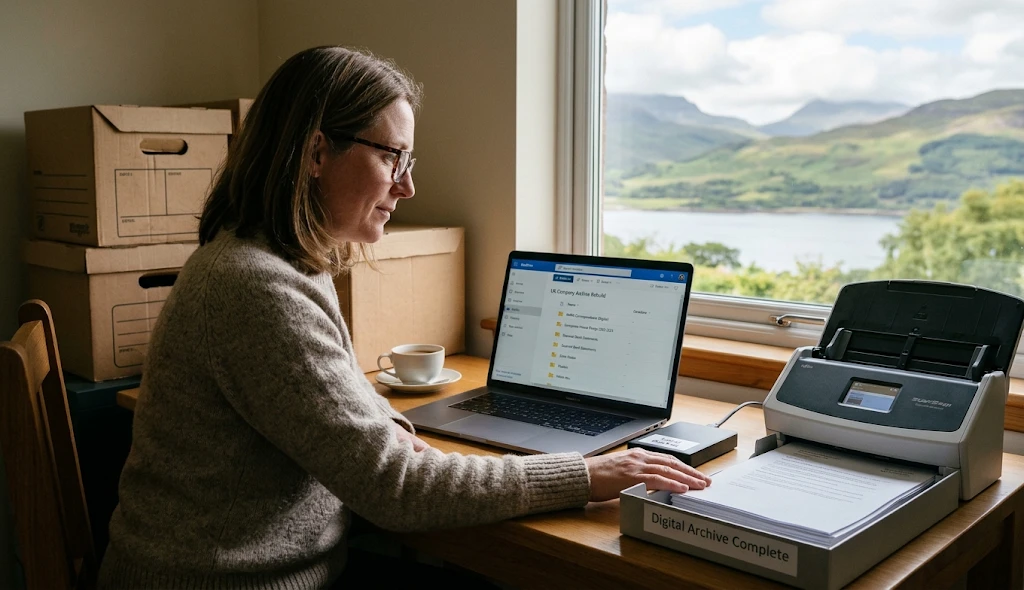
Directors who lost both the paper and the digital file have a longer task. They rebuild the full document archive from the public register. The guide on rebuilding your remote UK company archive after losing original paperwork explains the sequence in detail.
How Do You Store Digital and Printed Copies Securely?
Store digital copies in two encrypted locations and keep printed legal copies in a fireproof, access-controlled container. Dual storage protects against file corruption, device failure, and physical loss.
Redundancy protects the archive. Keep one digital set on a cloud service and one on an offline drive. Encryption protects both locations from unauthorised access.
Label every file with the document type and the date. Three labels cover most needs: certificate of incorporation, articles of association, and confirmation statement. Consistent names speed retrieval during bank applications.
Printed legal copies need physical protection. Heat, moisture, and handling damage paper. A sealed folder inside a fireproof container preserves the certificate, the seal, and the signature.
Non-UK residents hold a distinct storage challenge. The registered office address often sits in the UK, while the director lives abroad. Direct access to the paper original is limited. Request a certified copy to the director’s own address, and hold the registered-office copy as a secondary record.
Review the archive once each year. Check that digital files open correctly. Confirm that printed copies remain legible. Update the archive whenever the company files a change with Companies House.
What Is the Takeaway on Digital Versus Printed Company Documents?
Digital copies deliver speed for daily administration. Printed legal copies deliver certified proof for banks, regulators, and courts. A UK company holds both formats, and each format serves a separate verification purpose.
The distinction rests on authentication. A digital file proves a document exists. A certified or apostilled paper copy proves the document is a true record. Counterparties choose the standard, and the company supplies the matching format.
Online formation delivers the digital set in as little as 3 working hours. The paper set follows on request. Non-UK residents benefit from requesting the paper set before an overseas deadline arrives.
Non-Resident UK Company Formation supports international clients with the full document lifecycle, from online incorporation to the replacement of paper originals through its Duplicate Certificate of Incorporation service.



0 comments
No comments yet — be the first to share your thoughts.