
Do International Trademark Conflicts Affect Your Companies House Name Update?
Understand how international trademark conflicts can affect your Companies House name update. Explore potential legal risks, naming restrictions and practical steps to protect your brand during a UK company rebrand.
Yes, indirectly. Companies House does not check international trademarks, so approval is not blocked. Trademark owners abroad still enforce their rights against your new name. This creates legal exposure and can force a second name change.
Companies House processes name updates against its own register. It does not search trademark databases in the UK or abroad. A name approved by Companies House carries no trademark clearance. This article explains where the conflict risk sits and how non-UK residents verify a name before filing.
Does Companies House check international trademarks before approving a name change?
No. Companies House checks a proposed name against the UK register of company names, plus rules on sensitive words and offensive terms. It does not search trademark registers in the UK, the EU, the US, or any other jurisdiction.
The Companies Act 2006 governs company names. Section 53 prohibits names that are the same as another registered name. Companies House rejects identical names at filing. It also reviews names containing sensitive words such as “Bank”, “Royal”, or “Chartered”, which require supporting documents.
Trademark rights sit in a separate system. The UK Intellectual Property Office (UKIPO) administers UK trademarks. Each country runs its own register. Registering a company name creates no trademark right and no exclusive claim to the name.
An approved name therefore signals only one fact. No identical name exists on the UK company register. Every other conflict stays unchecked.
How do international trademark conflicts affect a UK company name after approval?
A trademark owner in another country enforces its rights against your trading activity. Enforcement targets use of the name in that market, such as websites, marketplaces, and invoices. The UK certificate does not protect you there.
Trademark rights are territorial. A brand registered in the United States binds activity in the United States. A brand registered in the European Union binds activity across its 27 member states. Your UK limited company name carries no force in those markets.
Non-resident companies trade internationally by design. A UK company with directors in Pakistan or the UAE sells to customers in multiple regions. Each region has its own register and its own enforcement route.
Three enforcement actions follow a conflict: cease-and-desist letters, marketplace takedowns, and domain disputes. Marketplace takedowns remove product listings. Domain disputes proceed through the Uniform Domain-Name Dispute-Resolution Policy administered by WIPO. Each action disrupts trading and forces a rebrand.
Which conflicts carry the highest risk?
Identical marks in the same industry carry the highest risk. Similar marks in related classes follow. Well-known marks receive broader protection across unrelated sectors. A name resembling a famous global brand draws enforcement even outside that brand’s sector.
Which UK rules apply when a name conflicts with an existing brand?
The Company Names Adjudicator at the UKIPO resolves complaints that a registered name is too similar to an existing name with goodwill. Passing off and trademark infringement claims proceed through UK courts.
Section 67 of the Companies Act 2006 lets the Secretary of State direct a name change. The direction applies where a name is too similar to an existing registered name. A complaint under this section carries a 12-month window from registration.
Section 69 allows a complainant to apply to the Company Names Adjudicator. The applicant shows goodwill in a name. The adjudicator decides whether your company name is the same as, or sufficiently similar to, that name. A successful complaint produces an order to change your name.
UK courts handle two further claims. Trademark infringement applies where your name copies a registered UK mark. Passing off applies where your name misleads customers about the source of goods.
A name change forced by these routes costs time. It also requires fresh filings with Companies House. Verifying the name before filing removes that sequence.
How do non-UK residents verify trademark conflicts before filing a name change?
Search five sources before filing: the UKIPO register, the EUIPO TMview database, the WIPO Global Brand Database, the USPTO database, and the Companies House register. Each search covers a distinct jurisdiction or registry.
Start with the UKIPO trademark search. It lists registered and pending UK marks by word and class. Filter by the classes matching your business activity.
Run the same search in the WIPO Global Brand Database. WIPO administers the Madrid System, which covers over 130 countries. The database aggregates records from national registers and international registrations. It returns results across multiple jurisdictions in a single query.
Search TMview for EU marks. Search the USPTO database for US marks. Match your target markets to the registers you query.
Then check domain and marketplace availability. A free domain does not prove a free name. A matching domain registered by a brand owner signals an active claim.
Record each search with its date and result. This record supports your position if a dispute arises later.
What does the Companies House name change process involve for non-residents?
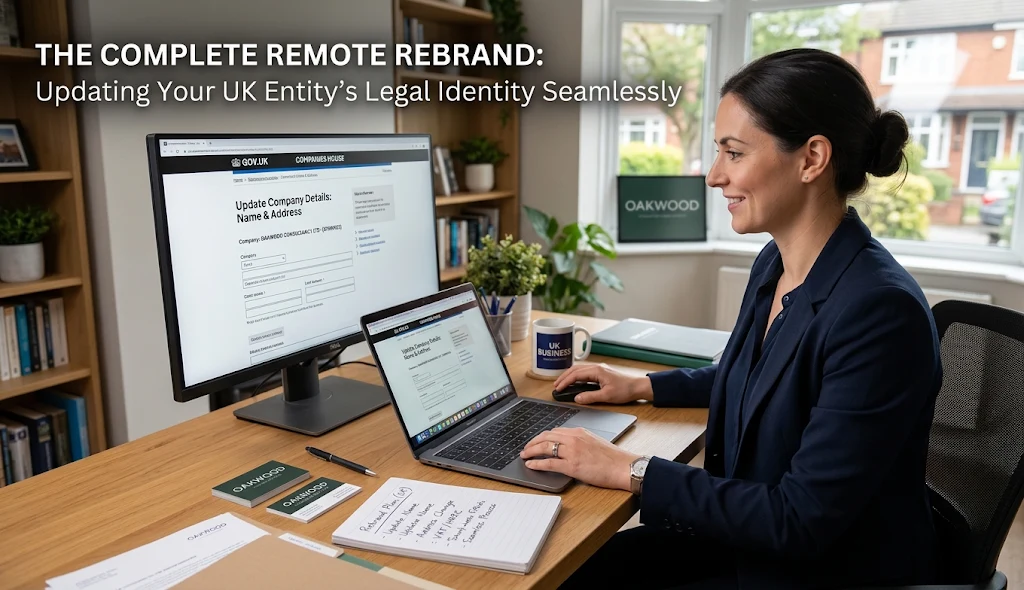
A non-resident files the change online using a special resolution and the company’s Web Filing Authentication Code. Companies House then issues a new certificate of incorporation on change of name.
The process follows four steps. Members pass a special resolution, which requires 75% of votes cast. The company submits the change through Companies House. The company authenticates the filing with its Web Filing Authentication Code. Companies House reviews the application and registers the new name.
The authentication code sits in your company summary page online. It identifies the company as the authorised filer. Filing without it is not possible through the online route.
A name change takes legal effect on the date shown on the new certificate. Banks, tax authorities, and trading partners recognise that certificate as proof of the new name. Our guide on why official certificates of incorporation on change of name matter globally explains how overseas institutions use it.
Processing times depend on Companies House. They exclude weekends and bank holidays. Delays occur when information or documents are incomplete or incorrect. Technical or application-related complexities also extend processing. Complete and accurate submissions move fastest. For comparison, a company formation completes online in as little as 3 working hours under the same conditions: accurate information and all legal and ID checks completed.
A Non-Resident Company Name Change service structures the filing around these requirements. It covers the resolution, the authentication step, and the application to Companies House.
What is the key takeaway on trademark conflicts and Companies House name updates?
Companies House approves names against the UK company register only. Trademark clearance is a separate task. Searching five registers before filing protects your company from forced rebrands in overseas markets.
International trademark conflicts do not stop a Companies House filing. They surface later through enforcement actions, takedowns, and adjudicator complaints. The risk grows with each market your company serves.
Verify the name first. Search the UKIPO, EUIPO, WIPO, and USPTO registers. Record the results. File the name change only after the searches confirm no conflict.
Non-Resident UK Company Formation delivers this process for non-UK residents. Its team handles the resolution, the authentication code step, and the filing. Directors who want to complete a company name change online follow one structured route from search to certificate.



0 comments
No comments yet — be the first to share your thoughts.