
Why Do Official Certificates of Incorporation on Change of Name Matter Globally?
An official Certificate of Incorporation on Change of Name confirms your company’s new legal identity. It supports international business transactions, banking, regulatory compliance and global credibility across jurisdictions.
Official Certificates of Incorporation on Change of Name prove your company’s new legal name to banks, regulators, and foreign authorities. Companies House issues the certificate under the Companies Act 2006, and the new name takes effect from the date. The company number and legal obligations stay unchanged.
What Is an Official Certificate of Incorporation on Change of Name?
It is the document Companies House issues after registering a new company name. It confirms the new name, the company number, and the date of change. Companies House issues it under section 80 of the Companies Act 2006.
The certificate records three data points: the new company name, the company number, and the effective date. Companies House issues it only after the company completes a valid name change.
A company changes its name by special resolution. A special resolution requires 75% of votes in favour. Companies also use any other method their articles of association allow.
The company then files form NM01 with Companies House. Companies House checks the proposed name against the register of company names and its naming rules. It rejects a name that is identical to an existing name. It also rejects a name that contains a sensitive word without the required approval.
Companies House processing times exclude weekends and bank holidays. Delays occur when information or documents are incomplete or incorrect. Complete filings with accurate details reduce the risk of rejection.
Why Do Foreign Banks and Regulators Require the Certificate?
Foreign banks and regulators require the certificate because it is the primary government-issued evidence of the name change. It links the former name to the new name under one company number. Compliance teams use it to update records and complete due diligence.
Financial institutions apply customer due diligence rules. FATF Recommendation 10 sets the international standard for this process. Banks verify the legal name, registration number, and ownership of every corporate customer. A changed name breaks the match between their records and public registers until they receive proof of the change.
Three document types support that proof: the certificate itself, the updated Companies House record, and the board or shareholder resolution. The certificate carries the most weight because a public authority issues it.
Payment processors, tax authorities, and licensing bodies follow the same logic. Each one matches the company name on their file to the name on the register. The certificate supplies that match in a single document.
Non-UK resident directors deal with institutions in several jurisdictions at once. One certificate serves all of them. The company supplies the same document to each institution instead of drafting separate explanations.
How Does the Certificate Protect Contracts and Legal Standing Across Borders?
The certificate protects legal standing because a name change does not affect the company’s rights or obligations. Section 81 of the Companies Act 2006 confirms that existing contracts, legal proceedings, and property rights continue under the new name.
A name change alters the label, not the legal entity. The company number stays the same. The company remains the same legal person before and after the change.
Counterparties in other countries verify this continuity through the certificate. Three common examples show the effect: supply agreements, loan agreements, and licence agreements. Each stays valid under the new name. The certificate gives the other party documentary proof that the contracting entity has not changed.
Registered rights follow a separate route. Intellectual property offices keep their own records. The UK Intellectual Property Office, the EUIPO, and the World Intellectual Property Organisation each update the owner name on request. The certificate supports each request.
Name conflicts also affect timing. A new name that clashes with a registered trademark abroad creates dispute risk. Read more on international trademark conflicts and your Companies House name update before you finalise the name.
When Does a Certified Copy or Apostille Add Value?
A certified copy or apostille adds value when a foreign authority demands proof beyond the digital certificate. Companies House issues certified copies of the certificate, and the UK Legalisation Office attaches the apostille for countries within the Hague Apostille Convention.
Many foreign authorities accept the digital certificate. Some require a certified copy. Others require an apostille, which authenticates the signature and seal on a public document.
The Hague Apostille Convention covers more than 120 contracting states. A document with an apostille is accepted in each of them without further legalisation. Countries outside the convention require consular legalisation. That process adds steps through the destination country’s embassy.
Three situations commonly trigger these requirements: opening a foreign bank account, registering a branch, and enforcing a contract in a foreign court. Each authority sets its own rules. Confirm the requirement with the receiving authority before ordering documents.
Order the certificate first. The apostille route starts only after Companies House issues the certified copy. Processing times for each stage exclude weekends and bank holidays. Plan the sequence of stages before the foreign deadline.
How Do You Evaluate a Non-Resident Company Name Change Provider?
Evaluate a provider on three criteria: filing accuracy, document handling, and post-change support. A Non-Resident Company Name Change service submits the resolution and form NM01, then delivers the certificate to an international client online.
Filing accuracy comes first. Companies House rejects filings with errors in the resolution wording, the proposed name, or the company details. A provider that checks each item before submission reduces rejections and delays.
Document handling comes second. The provider receives signed resolutions from directors abroad. It supplies the certificate in a format that foreign institutions accept. Check whether the provider supports certified copies for overseas use.
Post-change support comes third. The certificate starts a chain of updates across banks, tax records, and registers. A provider that explains each update shortens that chain.
Service scope matters for non-UK residents. A provider built for international clients handles remote signing and cross-border document delivery as standard steps. You can complete a Non-Resident Company Name Change without travelling to the UK.
What Steps Follow the Certificate After a Remote Rebrand?
After receiving the certificate, update seven records: bank accounts, tax registrations, contracts, trademark filings, website notices, licences, and statutory registers. Each update applies the new name consistently and keeps the company’s records aligned with the public register.
Start with the bank. Submit the certificate to every bank and payment provider that holds company accounts. Request written confirmation that the account name has changed.
Update tax registrations next. Notify the relevant tax authorities in each jurisdiction where the company is registered. Match the name on every tax record to the name on the certificate.
Update contracts and licences after that. Notify counterparties in writing and attach the certificate. Amend any licence held in the former name with the issuing body.
UK law requires the company name to appear on its website, business letters, and invoices. Replace the former name on each of these. Update the company’s own statutory registers, including the register of members and the register of directors.
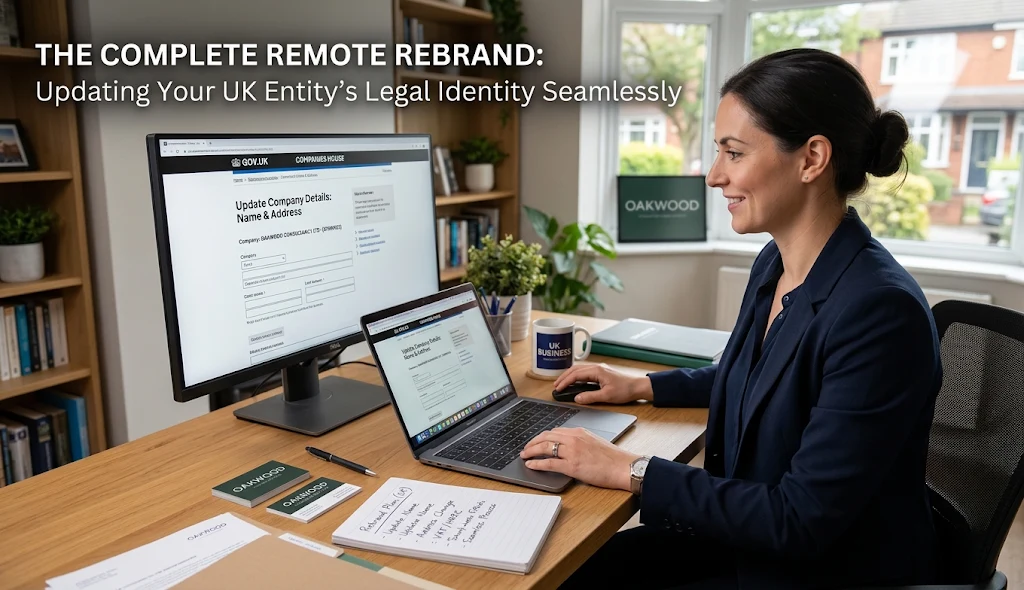
A structured sequence prevents mismatches between records. Read the complete remote rebrand of your UK entity’s legal identity for the full process.
What Does the Certificate Mean for Your Global Rebrand?
The certificate is the single document that makes a name change valid worldwide. It proves the new legal name, confirms continuity of obligations, and supports every follow-up update with banks, regulators, and registries.
The certificate converts a board decision into a verifiable public record. Foreign banks, regulators, and counterparties accept it because a UK public authority issues it. Certified copies and apostilles extend that acceptance to countries with stricter proof rules.
A name change protects the company’s legal standing, but it requires accurate filings. Complete information and correct resolution wording prevent rejection by Companies House. Delays occur where documents are incomplete or incorrect.
Non-Resident UK Company Formation delivers this process for non-UK residents. The Non-Resident Company Name Change service covers the resolution, the NM01 filing, and online delivery of the certificate to directors abroad.



0 comments
No comments yet — be the first to share your thoughts.