
How Do UK Companies Approve Name Changes Remotely Using Special Resolutions or Articles Authorisation?
Learn how UK companies approve name changes remotely through a special resolution or articles authorisation. Understand the legal requirements, approval procedures and Companies House filing process for changing a company name.
Non-UK resident entrepreneurs can approve a UK company name change remotely by passing a special resolution requiring a 75% director or shareholder majority, or by following specific authorisation procedures outlined in the company’s Articles of Association. Once approved, you file the change online with Companies House for official processing.
What Is the Difference Between Special Resolutions and Articles Authorisation?
A special resolution requires a formal 75% voting majority from shareholders to approve a name change, whereas Articles authorisation relies on predefined director powers written directly into the company’s founding Articles of Association.
Company law in the UK establishes two primary mechanisms for changing a corporate name. A special resolution represents the standard statutory route under the Companies Act 2006. Shareholders voting on a special resolution must deliver a 75% majority vote to pass the motion. Directors must document this vote in written form when managing the process remotely. Non-resident directors send written resolution copies to all voting members using secure digital channels.
Articles authorisation operates through custom provisions written into a company's governing rules. Certain Articles of Association grant directors explicit authority to alter the company name without shareholder votes. Directors review their existing Articles of Association to confirm if this administrative power exists. Approving name changes through board-level Articles authorisation saves administrative time for multi-member entities.
Remote management requires strict adherence to corporate documentation standards. Directors record all decisions in formal board minutes or written resolution records. Non-UK residents store these digital records within their statutory books. Processing through established corporate channels ensures your business remains fully compliant with UK legal frameworks.
How Do Non-UK Directors Pass a Special Resolution Remotely?
Non-UK directors pass a special resolution remotely by circulating a written resolution document digitally to all shareholders, collecting electronic signatures, and securing approval from members holding at least 75% of total voting rights.
The written resolution process allows overseas business owners to vote without holding physical meetings. Directors draft the written resolution stating the exact proposed new company name. The draft must display the target name precisely as intended for official registration. Directors distribute this document to all eligible voting members via secure electronic communications.
Shareholders review the resolution details and cast their votes electronically. A special resolution succeeds only when members holding 75% of total voting rights sign their approval. Non-resident directors must track responses to ensure the threshold is met within 28 days. Directors record the precise date when the resolution reaches the required 75% majority mark.
After securing the necessary votes, directors prepare the resolution for official filing. You must retain signed copies of the written resolution in your corporate record archives. You can streamline this administrative process by utilising Non-Resident Company Name Change to handle filings accurately. Proper execution prevents statutory non-compliance issues during corporate reviews.
How Do Articles of Association Grant Directors Authority to Change Names?
Articles of Association grant authority by including specific clauses that empower directors to change the company name via a simple board resolution, bypassing the standard 75% shareholder vote requirement.
Model Articles of Association provide default rules for UK entity governance. Standard Model Articles require shareholder approval through a special resolution for name changes. However, bespoke Articles can modify these standard procedures. Founders often include specialised clauses during initial incorporation to streamline future administrative modifications.
When Articles authorise director-led changes, board members pass a resolution during a remote board meeting. Alternatively, directors sign a written board resolution approving the corporate name update. This mechanism reduces administrative steps for international holding structures and single-director entities. Directors must verify that their current Articles contain this exact provision before proceeding.
Executing an unauthorised name change invalidates the statutory filing. Directors examine their statutory documents to verify whether board authorisation applies. If the Articles lack explicit director authorisation provisions, the company must execute a standard special resolution. Following correct constitutional pathways protects your business from administrative rejections by regulatory authorities.
What Documents Must You Submit to Companies House for a Remote Name Change?
You must submit Form NM01 for special resolutions or Form NM02 for Articles authorisation, accompanied by a copy of the passed resolution, to Companies House for legal processing.
Statutory requirements mandate specific documentation for every corporate name change. Companies changing names via special resolutions must complete Form NM01. Entities utilising board authority under their Articles of Association complete Form NM02 instead. Submitting the incorrect form results in immediate rejection by statutory registrars.
Accurate data entry ensures smooth administrative processing. Form NM01 requires the exact existing company name, company registration number, and proposed new name. Directors must attach a copy of the written special resolution to the filing. Form NM02 requires references to the specific clause in your Articles authorising director action.
Digital submissions are processed faster than physical paper documents submitted by post. Non-UK residents utilise online portal systems to transmit application packages securely. You can form a company online in as little as 3 working hours if you submit complete, accurate information and complete all required legal and ID checks. Web Filing Authentication Codes provide digital validation for secure electronic submittals.
How Fast Does Companies House Process Remote Name Change Applications?
Companies House processes online name change applications within 24 to 48 hours on business days, provided all corporate documentation and legal checks are complete and accurate.
Standard online processing moves rapidly through statutory systems. Web filings receive automated queuing upon successful electronic submission. Your Web Filing Authentication Code will be provided online through your company summary page. This digital code authenticates your corporate authority directly on the submission system.
Processing times depend on Companies House processing and exclude weekends and bank holidays. Delays can occur where information or documents are incomplete or incorrect, or where technical or application-related complexities require additional processing. Overseas business owners must account for UK public holiday schedules when planning corporate rebrand schedules.
Once processed, Companies House issues an official Certificate of Incorporation on Change of Name. This digital document displays the official effective date of your entity's new corporate identity. The legal name change takes effect only when the registrar issues this certificate. Retain this digital document alongside your original incorporation filings.
What Common Name Restrictions Cause Rejections During Filings?
Companies House rejects name changes that match existing registered names, contain sensitive or protected terms without permission, or include misleading corporate designations.
The UK registrar enforces strict guidelines regarding corporate name availability. A proposed name cannot be identical to or virtually the same as an existing registered company. Minor variations like punctuation, spaces, or formatting do not make names distinct under statutory rules. Directors perform thorough name searches across statutory databases prior to passing internal resolutions.
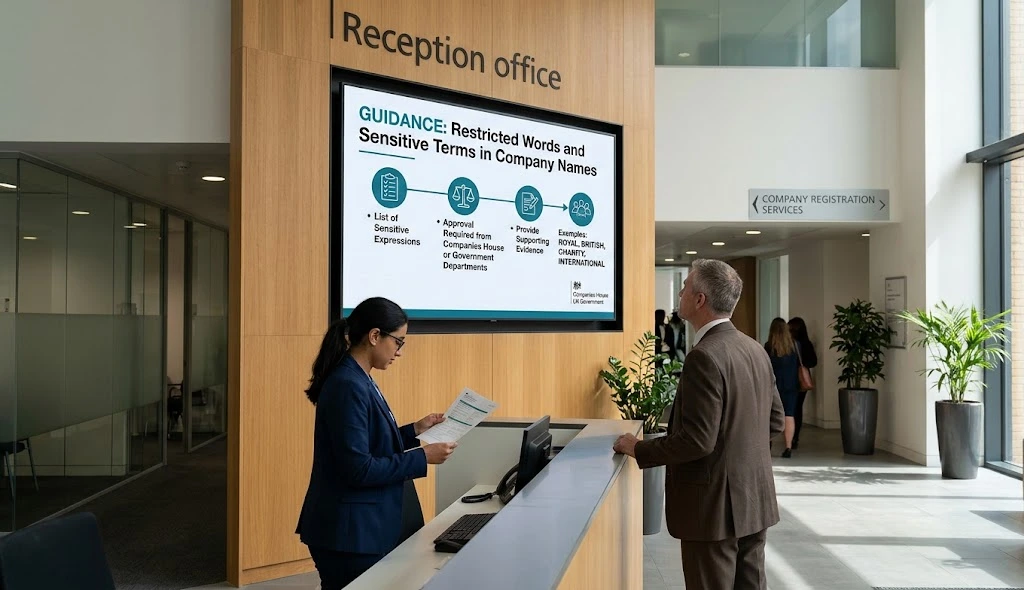
Sensitive words require explicit government permissions or supporting regulatory documentation. Words suggesting official authority, international reach, or regulated activities demand specialised approval letters. Terms like "Bank," "Insurance," "Royal," or "Group" trigger manual reviews by registration officers. Submitting sensitive names without required authorisation letters guarantees application rejection.
Name choices must align with legal entity structures. Limited companies must end with "Limited" or the abbreviation "Ltd." Selecting inappropriate suffixes leads to processing failures. Evaluating your branding trajectory early helps avoid unnecessary filings. Reviewing Why Branding Outgrows Incorporation: Signs Your UK Entity Needs a New Title provides clarity on when structural title updates become necessary for growing entities.
What Post-Approval Steps Must Non-UK Businesses Complete Immediately?
Non-UK businesses must update statutory registers, inform HMRC, notify banking partners, and modify official business communications immediately after receiving the Certificate of Incorporation on Change of Name.
Receiving the official certificate triggers immediate post-approval compliance obligations. UK company law requires entities to update their internal statutory registers within 14 days. You must update your Register of Directors, Register of Members, and minute books to reflect the new corporate title. Digital statutory records must match official Companies House entries.
External stakeholders require prompt legal notification of your name change. Financial institutions demand certified copies of the new certificate to update corporate bank accounts. Tax authorities, payment processors, vendors, and clients must receive formal written notices. Updating commercial contracts ensures all ongoing business agreements maintain full legal enforceability.
Physical and digital company collateral must display updated legal details. UK regulations mandate that corporate websites, email footers, invoices, and business letters display the new legal name alongside the registered number and office address. Following a comprehensive Post-Filing Checklist: Updating Your Registered Office and Service Address Records ensures your corporate records remain fully updated across all statutory systems.
How Do Remote Services Support Non-Resident Name Change Filings?
Remote corporate services support non-residents by reviewing documentation, drafting legally compliant resolutions, and executing online filings directly with UK statutory authorities.
Managing UK regulatory filings from abroad introduces logistical and administrative challenges. International business owners frequently face time-zone differences and strict documentation rules. Professional corporate providers streamline these administrative steps through managed digital platforms. Non-Resident UK Company Formation provides dedicated corporate governance solutions designed specifically for international entrepreneurs operating UK entities.
Specialised filing assistance prevents common processing errors. Corporate specialists verify name availability, draft custom written resolutions, and prepare statutory forms accurately. Non-Resident UK Company Formation manages portal submissions to ensure full compliance with Companies House guidelines. This structured support eliminates processing delays and protects your legal standing.
Maintaining complete compliance allows your business to focus on international growth. Leveraging expert support ensures every resolution, board minute, and web filing meets statutory standards. Partnering with Non-Resident UK Company Formation provides ongoing peace of mind for non-resident business owners navigating UK company administrative requirements.



0 comments
No comments yet — be the first to share your thoughts.