
Why Does Branding Outgrow Incorporation and When Should a UK Entity Change Its Name?
Discover when your UK company name no longer reflects your brand identity. Explore the key signs that indicate your business needs a new title to strengthen recognition, credibility and market positioning.
A UK entity requires a new title when the original corporate name limits market expansion, causes trademark conflicts, creates geographic restrictions, or misaligns with evolved commercial services. Updating the legal title aligns registered corporate structures with active brand identity, protecting market equity and statutory compliance.
Commercial operations frequently outgrow initial registration parameters. Entrepreneurs often select company names during early incorporation stages based on narrow initial offerings or localised target markets. As trading operations scale internationally, existing legal names create structural friction between brand perception and statutory filings.
Companies House records require exact corporate identification for all contracts, banking arrangements, and regulatory disclosures. Maintaining an outdated corporate name dilutes brand clarity across foreign jurisdictions. International directors must evaluate registered entities periodically to ensure corporate structures support broader commercial objectives.
What Structural Indicators Signal That a UK Company Name Is Obsolete?
Three key structural indicators signal name obsolescence: product line diversification beyond initial terms, geographic expansion past local identifiers, and persistent customer confusion between trading names and legal entities. Recognising these operational shifts prevents regulatory friction and brand equity erosion.
Initial company registration often utilises descriptive terms tied to specific product categories. When an entity expands from singular software distribution into multi-sector enterprise consulting, legacy descriptive names misrepresent actual operations. Statutory records must reflect current business scope to maintain transparent corporate identity.
Geographic markers inside legal names restrict cross-border scaling. A corporate title containing regional identifiers creates operational friction when tendering for contracts in new international markets. Overseas clients and institutional financial providers require clear, unrestricted entity branding during onboarding verifications.
Divergence between public trading styles and registered legal entities introduces administrative overhead. Managing dual identities requires multiple bank accounts, complex trading disclosures, and additional trademark filings. Aligning the registered name with the active trading identity eliminates duplicate compliance requirements across international operating jurisdictions.
How Does a Legal Name Change Protect Corporate Equity and Trademarks?
A legal name change protects corporate equity by securing exclusive statutory rights under the Companies House framework, eliminating trademark infringement risks, and consolidating enterprise goodwill under a single enforceable entity title. Proper registration prevents third parties from registering confusingly similar corporate names.
Corporate naming rights in the United Kingdom depend on formal registration with Companies House. Operating under an informal trading style without altering the underlying statutory entity leaves the primary brand vulnerable to registration by third parties. Formal name modification secures statutory ownership over the exact corporate title.
Unaligned corporate names increase intellectual property liability across global target markets. When trading identity diverges from registered corporate documentation, cross-border trademark enforcement becomes complex. Aligning corporate titles with registered trademarks strengthens legal standing during intellectual property disputes.
International banks and payment processors enforce strict identity verification policies. Discrepancies between invoice titles, contractual documents, and Companies House records trigger compliance holds. Updating official statutory records streamlines cross-border payment processing, merchant account approval, and corporate banking compliance.
What Role Does Corporate Governance Play in Naming Adjustments?
Corporate governance protocols dictate how structural changes are executed within a UK company structure. Board members must evaluate constitutional documents before initiating legal name adjustments. The company's articles of association dictate the specific internal approval mechanisms required for modifying corporate identity.
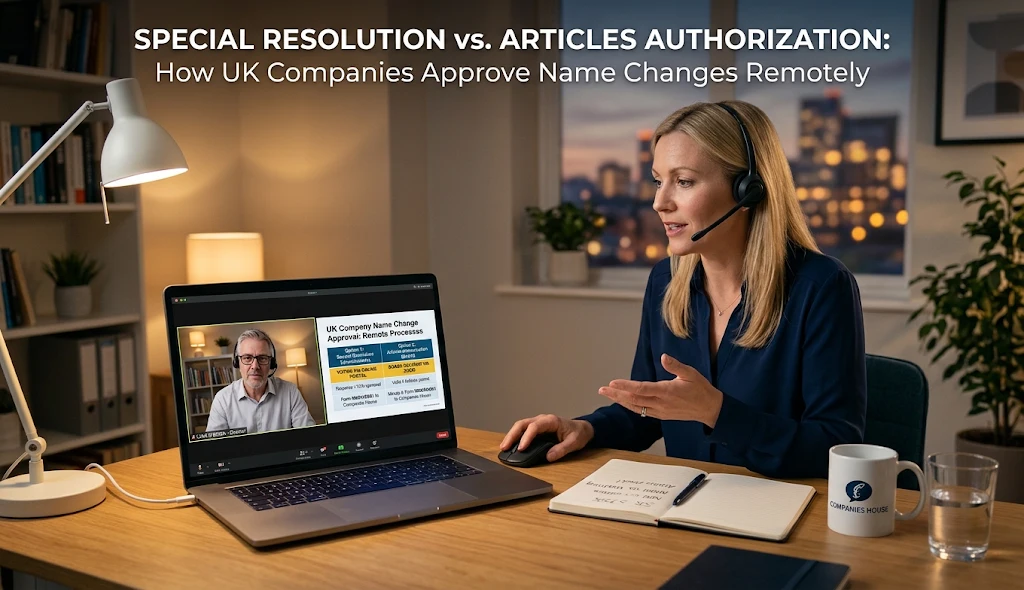
Shareholder approval forms the foundational requirement for formal company name modifications. Directors submit official proposals to change registered corporate titles, initiating formal voting procedures. Understanding Special Resolution vs. Articles Authorisation: How UK Companies Approve Name Changes Remotely ensures compliant corporate decision-making across distributed international boards.
Proper governance prevents procedural invalidations by foreign courts or regulatory bodies. Filing certified corporate resolutions confirms that all corporate actions meet Companies House requirements. Documenting statutory approvals protects directors against shareholder disputes and regulatory non-compliance penalties.
What Technical Steps Are Required to Change a UK Company Name Online?
Changing a UK company name online requires three technical steps: passing an internal company resolution, submitting form NM01 to Companies House, and obtaining a new Certificate of Incorporation on Change of Name. Digital filings are processed within three working hours when documentation is accurate.
The technical process begins with verifying name availability on the Companies House index. Proposed titles must avoid sensitive words, existing registered trademarks, or identical corporate names. Verification tools validate availability before official filing documentation is submitted to statutory registers.
Following name availability confirmation, directors draft and execute internal corporate approvals. The legal change executes officially upon submission of Companies House Form NM01 alongside the approved resolution text. Submitting applications via electronic filing systems ensures efficient transmission to statutory processing queues.
Companies House reviews submitted documents against statutory standards and identity verification frameworks. A company can be formed online or updated in as little as 3 working hours when complete and accurate information is submitted, and all necessary legal and ID checks are completed. Processing times depend on Companies House processing and exclude weekends and bank holidays. Delays can occur where information or documents are incomplete or incorrect, or where technical or application-related complexities require additional processing.
Upon successful registration, Companies House issues an official Certificate of Incorporation on Change of Name. Your Web Filing Authentication Code will be provided online through your company summary page. This statutory document establishes the exact date when the legal title transition takes effect.
How Do Non-Resident Directors Manage UK Statutory Name Updates Remotely?
Non-resident directors manage remote UK statutory name updates by using online company portals, submitting digital identity verification, executing electronic resolutions, and delegating filing tasks to authorised UK corporate service providers. Digital workflows eliminate physical presence requirements.
International directors face unique administrative hurdles when managing UK entities from abroad. Cross-border postal delivery introduces delays in submitting physical documentation to Companies House. Digital filing platforms provide secure channels to execute statutory filings without physical paperwork.
Remote identity verification frameworks validate overseas directors using official international documents. Verification systems accept three primary identification items: valid international passports, national identity cards, and certified proof of residential address. Verifying director credentials ensures full compliance with UK anti-money laundering regulations.
Executing statutory updates remotely requires specialised knowledge of UK company administration law. Leveraging dedicated Non-Resident Company Name Change support ensures cross-border entities submit accurate resolutions, fulfil statutory filing conditions, and update registered business details efficiently.
What Administrative Updates Must Follow a Formal Name Change?
An official name update requires comprehensive administrative updates across all corporate systems. Directors must update business bank accounts, tax registrations, and contractual agreements immediately after receiving the new Certificate of Incorporation.
HM Revenue and Customs (HMRC) records require synchronisation with Companies House updates. Updating corporation tax files, Value Added Tax (VAT) registrations, and PAYE records prevents tax compliance errors. Financial institutions require certified copies of the new incorporation certificate to update account titles.
Commercial contracts require formal addendums to reflect the updated corporate title. Updating active supplier contracts, customer terms, and property leases maintains contractual enforceability. Prompt notification to international business partners preserves commercial relationships and operational continuity.
How Do Company Name Changes Impact International Tax and Regulatory Compliance?
Company name changes do not alter tax identification numbers, company registration numbers, or existing legal liabilities, but require immediate notification to international tax authorities and regulatory bodies. The underlying corporate identity remains identical under UK company law.
A corporate name change creates no separate legal person under UK corporate law. The original registered company number remains unchanged throughout the structural modification process. Existing debts, legal rights, and contractual obligations transfer seamlessly to the newly named entity.
International tax authorities track UK entities using official tax reference numbers rather than corporate titles alone. When international companies trade across borders, updating double taxation relief documentation prevents withholding tax complications. Maintaining consistent records across tax jurisdictions avoids cross-border audit risks.
Regulatory authorities overseeing specialised sectors require formal notification of corporate updates. Financial services, international trade logistics, and regulated professional services require updated licensing documents. Submitting corporate certificates promptly ensures continuous regulatory authorisation to operate.
Supporting International Entrepreneurs with UK Statutory Management
Managing structural changes for a UK corporate entity from outside the United Kingdom demands precise adherence to statutory rules. Non-Resident UK Company Formation provides dedicated corporate administration support structured exclusively for international business founders.
Navigating Companies House requirements, identity verification standards, and resolution drafting requires specialised administrative coordination. Non-Resident UK Company Formation delivers straightforward management solutions that streamline company modifications, maintain regulatory compliance, and support long-term corporate growth for non-UK residents operating worldwide.



0 comments
No comments yet — be the first to share your thoughts.