
Why Do Overseas Founders Need Physical Records Alongside Digital UK Corporate Filings?
Discover why overseas founders need physical company records alongside digital UK corporate filings. Learn how maintaining organised statutory documents supports legal compliance, business transparency and efficient company administration.
Overseas founders hold physical records because digital Companies House filings do not satisfy every bank, regulator, or foreign authority. Printed certificates, signed registers, and certified copies provide verifiable proof of company status when online access is unavailable, or a third party requires the original paper.
How Quickly Does a UK Company Form Online?
A UK company forms online in as little as 3 working hours when information is complete and accurate and all legal and ID checks clear. Your Web Filing Authentication Code appears on your company summary page after incorporation.
Speed is the main strength of digital incorporation. Companies House processes electronic applications faster than paper submissions. Processing times exclude weekends and bank holidays, so a Friday evening submission clears on the next working day.
Accuracy controls the timeline. Delays occur when information or documents are incomplete or incorrect. Technical or application-related complexities also extend processing. Director names, registered office addresses, and shareholder details must match the supporting evidence exactly.
Incorporation is the start of a compliance cycle, not the end. The company receives a registration number, a certificate, and statutory obligations. Each obligation produces records that overseas founders retain and organise.
What Does a Digital Incorporation Actually Deliver?
Digital incorporation delivers an electronic Certificate of Incorporation, a public register entry, and a Web Filing Authentication Code. These items confirm legal existence and enable online filing, but they exist only as electronic files and database entries.
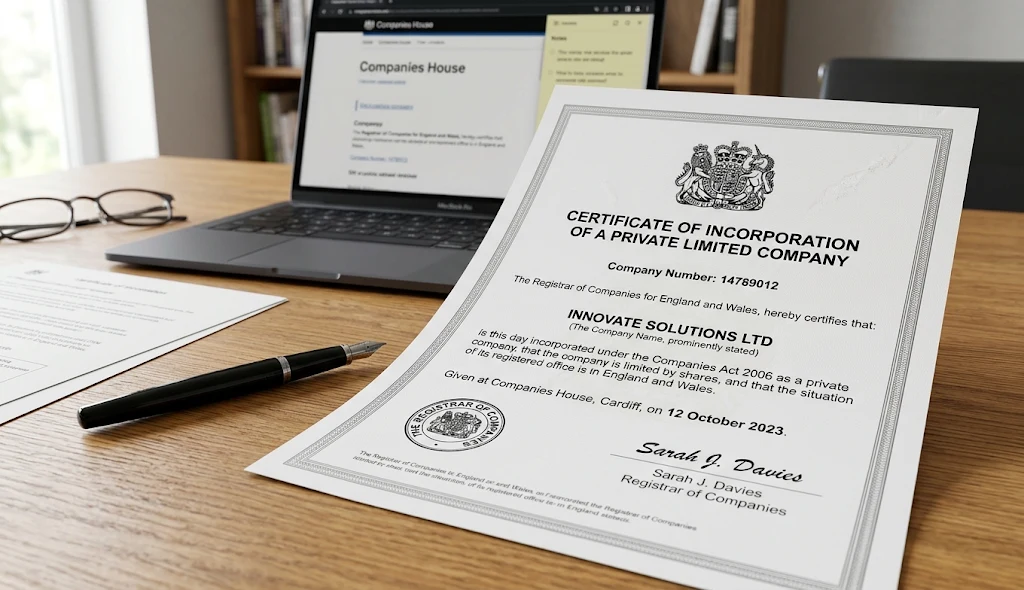
Companies House issues the Certificate of Incorporation as a digital document. It states the company name, registration number, and incorporation date. The public register lists officers, shareholders, and the registered office address.
The Web Filing Authentication Code is a six-character credential. It authorises online filings such as confirmation statements and officer changes. Founders who lose this code must request a replacement through Companies House.
Digital delivery creates a dependency on devices, email accounts, and internet access. Overseas founders often travel between jurisdictions with varying connectivity. A printed record removes this dependency and gives a fixed, portable proof of status.
Why Do Digital Filings Not Replace Physical Records?
Digital filings confirm what the register shows, but third parties often request original or certified paper. Banks, foreign registries, and licensing bodies commonly apply their own document standards, which a screenshot or PDF does not always satisfy.
Three types of institutions request paper evidence: banks opening corporate accounts, foreign authorities registering a branch, and payment providers completing due diligence. Each applies its own verification policy. Accepted formats vary by institution and jurisdiction.
Internal governance also depends on paper. Companies Act 2006 requires every company to keep statutory registers. Three core registers apply: members, directors, and persons with significant control. A company records these entries and makes them available for inspection.
Accounting records add a retention duty. UK private companies keep accounting records for six years from the end of the financial year. Founders who store only digital copies carry the full burden of backup and recovery.
Which Physical Records Do Overseas Founders Hold?
Overseas founders hold five core physical records: the Certificate of Incorporation, the memorandum and articles of association, statutory registers, share certificates, and certified copies of identity documents. Each record supports a distinct verification or governance function.
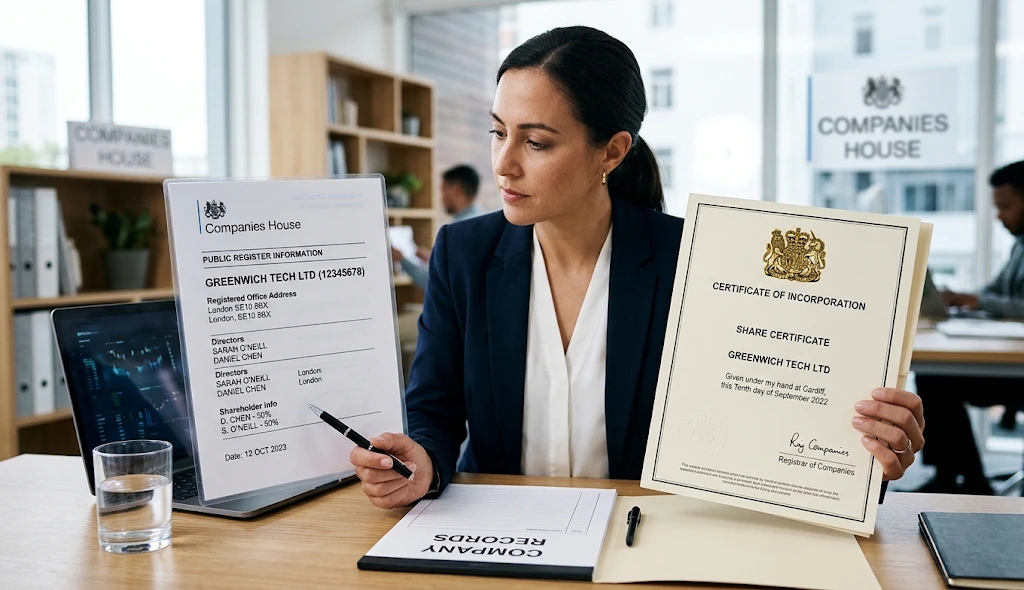
The Certificate of Incorporation proves the company exists. The articles of association define how the company operates. Share certificates evidence ownership for each shareholder. Statutory registers log members, directors, and persons with significant control.
Certified identity documents support identity verification. Companies House requires directors and persons with significant control to verify their identity. Verification became a legal requirement under the Economic Crime and Corporate Transparency Act 2023. Banks apply separate customer due diligence checks on top.
Founders maintain these records in two formats. The digital set supports daily filing and correspondence. The physical set supports audits, bank reviews, and cross-border legal procedures. Both sets must match the Companies House register.
How Does a Duplicate Certificate of Incorporation Protect Your Records?
A Duplicate Certificate of Incorporation replaces a lost, damaged, or unavailable original certificate. It gives the company a fresh copy of its core proof of existence, so banks, registries, and partners receive the document they request.
Loss and damage are the common reasons founders replace a certificate. International postage, relocation, and storage failures all cause document loss. A replacement restores the company’s primary evidence without altering any register entry.
The duplicate carries the same company name, number, and incorporation date as the original. Verifiers cross-check these details against the Companies House register. Matching data confirms authenticity quickly.
Founders who want a reliable replacement route can order a Duplicate Certificate of Incorporation before an urgent request arises. Holding a spare reduces delays during bank onboarding and foreign registry filings. The Duplicate Certificate of Incorporation also supports contract signings where a counterparty demands the certificate on file.
When Do Banks and Authorities Request Original Documents?
Banks and authorities request original or certified documents during account opening, branch registration, licence applications, and ownership disputes. Each situation requires proof that the company exists and that its officers hold verified authority.
Account opening is the most frequent trigger. Compliance teams collect the certificate, articles, and identity records for every director and shareholder. Gaps in the file stall the application.
Foreign market entry is the second trigger. A company registering a branch abroad submits UK incorporation proof to the local registry. Many registries request certified or legalised paper copies.
Founders choosing between a replacement and a certified set review the requirements of the receiving party first. This guide on assessing when a duplicate certificate versus certified formation papers applies explains the distinction in detail. A duplicate replaces the certificate itself. Certified formation papers confirm the authenticity of a wider document set.
How Do Overseas Founders Organise Physical and Digital Records Together?
Overseas founders organise records by keeping a matched digital archive and a secured physical file, then reviewing both after every Companies House filing. Consistency between the two sets prevents verification failures.
Start with a single master index. List every document, its issue date, and its storage location. Update the index each time the company files a change, such as a new director or a registered office update.
Store originals in a fireproof, access-controlled location. Keep scanned copies in encrypted cloud storage. Back up the Web Filing Authentication Code separately from the company email account.
Schedule a records review at each confirmation statement date. Companies file a confirmation statement at least once every 12 months. The review confirms that registers, certificates, and public filings still align.
Replace missing items immediately. A gap in the record set surfaces at the worst moment, usually during a bank review or a cross-border filing. A Duplicate Certificate of Incorporation closes the most common gap within the same process.
What Is the Practical Takeaway for Overseas Founders?
Digital filings create the company, and physical records prove it. Overseas founders protect their UK company by holding a verified certificate, current registers, and certified documents that match the Companies House register.
Online formation completes in as little as 3 working hours when information is accurate and checks clear. That speed does not remove the requirement for paper evidence. Banks, foreign registries, and regulators continue to request original or certified documents.
Non-Resident UK Company Formation supports this requirement for non-UK residents. Non-Resident UK Company Formation provides online incorporation, the Web Filing Authentication Code through the company summary page, and post-incorporation services such as the Duplicate Certificate of Incorporation. Founders gain a complete record set that satisfies both digital and physical verification standards.

0 comments
No comments yet — be the first to share your thoughts.