
Why Is the Certificate of Incorporation the Most Critical Document for Your UK Startup?
The Certificate of Incorporation officially confirms your UK company's legal existence. Discover why this essential document matters for business operations, banking, compliance and building credibility with customers and partners.
The Certificate of Incorporation serves as the official legal proof that a UK company exists as a distinct corporate entity. Issued by Companies House upon registration, it confirms your company number, incorporation date, and corporate structure, enabling banks, investors, and vendors to verify your legitimacy.
What Is a UK Certificate of Incorporation and What Information Does It Contain?
A UK Certificate of Incorporation is a legally binding document issued by Companies House that confirms the formal creation of a private limited company. It contains the official company name, unique company registration number, formation date, jurisdiction, and governing legal structure.
Companies House issues this instrument immediately after approving a company formation application. The document functions as a birth certificate for corporate entities operating within the United Kingdom legal framework.
Every legal document issued by the registrar contains specific legal identifiers. The document displays the exact registered name of your corporate entity. It features a unique eight-digit company registration number assigned during registration. The document records the precise calendar date of incorporation. It identifies the applicable legal jurisdiction, such as England and Wales, Scotland, or Northern Ireland. The text confirms whether the business operates as a private limited company, a public limited company, or a limited liability partnership.
International entrepreneurs require this document to prove that their legal structure possesses an independent legal personality. A legal entity exists separately from its directors and shareholders under UK corporate law. Without this legal document, third parties cannot confirm whether your enterprise possesses the legal capacity to enter contracts. The document remains permanently unchanged throughout the lifespan of your commercial enterprise.
Why Do Banks and Financial Institutions Require Your Certificate of Incorporation?
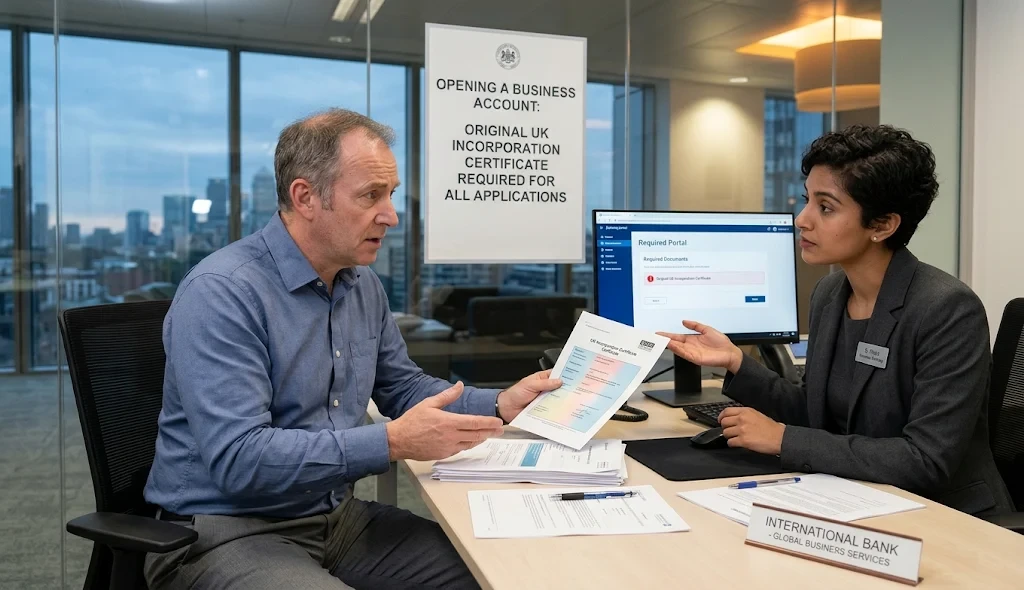
Financial institutions require your Certificate of Incorporation to verify corporate existence, fulfil anti-money laundering regulations, and validate legal authority before opening business bank accounts. Corporate banking providers cross-reference the official document details against government registry databases to prevent fraud.
Commercial banking providers enforce strict Know Your Customer protocols under modern financial regulations. When non-UK residents apply for international merchant accounts or UK business accounts, financial institutions demand primary proof of legal establishment. Compliance officers examine the document to verify that your company number matches official registry records.
Corporate financial transactions require absolute legal certainty. Payment gateways, payment service providers, and merchant acquirers demand the document during merchant onboarding. Financial institutions cross-reference the registered office address and formation date against your application data. Discrepancies between your corporate records and application forms trigger immediate compliance holds.
International banks operate under strict anti-money laundering laws. Verifying your certificate allows compliance teams to trace ultimate beneficial ownership structures accurately. Establishing corporate bank accounts becomes impossible without presenting a verified copy of this constitutional record.
How Does the Certificate of Incorporation Enable Global Commercial Contracting?
The Certificate of Incorporation enables commercial contracting by proving that your company possesses legal standing to execute contracts, lease assets, and enforce agreements. Corporate vendors, suppliers, and international clients require this document to confirm legal capacity before executing binding deals.
Executing commercial agreements requires legally verified counterparties. Foreign vendors and UK suppliers demand proof of legal incorporation before signing supply agreements or enterprise service contracts. The certificate proves that your business entity can incur debt, purchase assets, and assume contractual obligations under law.
Commercial landlords and equipment vendors inspect incorporation credentials before granting commercial leases or credit facilities. They use the unique company registration number to run corporate credit checks and evaluate commercial liability risks. Without valid registration documents, your enterprise cannot legally bind itself to third-party commercial contracts.
International trade operations depend entirely on verified corporate credentials. Customs authorities, freight forwarders, and overseas distributors request incorporation proof to clear shipments and grant international trading rights. Displaying verified corporate credentials builds immediate trust across foreign borders and establishes contractual enforceability.
Why Do Investors and Lenders Demand Verification of Incorporation Status?
Investors and lenders demand verification of incorporation status to confirm equity ownership rights, validate corporate debt capacity, and complete due diligence protocols. The document proves that the business operates legally as a structured entity capable of issuing shares.
Venture capital firms, angel investors, and commercial lenders initiate corporate due diligence by reviewing fundamental formation records. Investors must verify that the corporate vehicle offering equity actually exists under UK law. The Certificate of Incorporation confirms the founding legal structure under which investment share capital is issued.
Corporate valuation processes require authentic legal documentation. Lenders inspect registry numbers to confirm that no hidden corporate liens, insolvency filings, or regulatory dissolution orders exist against the entity. The document links directly to public filings recorded at Companies House.
Securing institutional debt or equity funding requires absolute documentation accuracy. Investment agreements rely on the precise corporate details listed on the original formation record. Failing to present authentic registration details delays capital deployment and breaks transaction negotiations.
What Are the Consequences of Misplacing Your Original Incorporation Certificate?
Misplacing your original Certificate of Incorporation halts banking operations, delays investor funding, blocks merchant account approvals, and stalls international contract negotiations. Enterprise operations freeze when third parties cannot verify your active legal status through authentic documentation.
Losing access to your formation credentials creates immediate administrative bottlenecks. International payment processors audit merchant accounts periodically and suspend payout capabilities if updated legal proof is missing. Banking portals lock transfer capabilities when corporate verification files expire or become unverified.
Cross-border commercial negotiations stall rapidly when counterparties request immediate corporate verification. International clients frequently set strict 48-hour compliance windows for submitting certified corporate documents. Missing these compliance deadlines leads to cancelled service agreements and lost commercial opportunities.
Operating without accessible legal records exposes foreign directors to administrative friction. Resolving legal verification issues across different time zones creates operational stress and operational delays. Maintaining immediate access to certified legal duplicates protects your ongoing commercial activities.
How Do You Replace a Lost Certificate of Incorporation from Abroad?
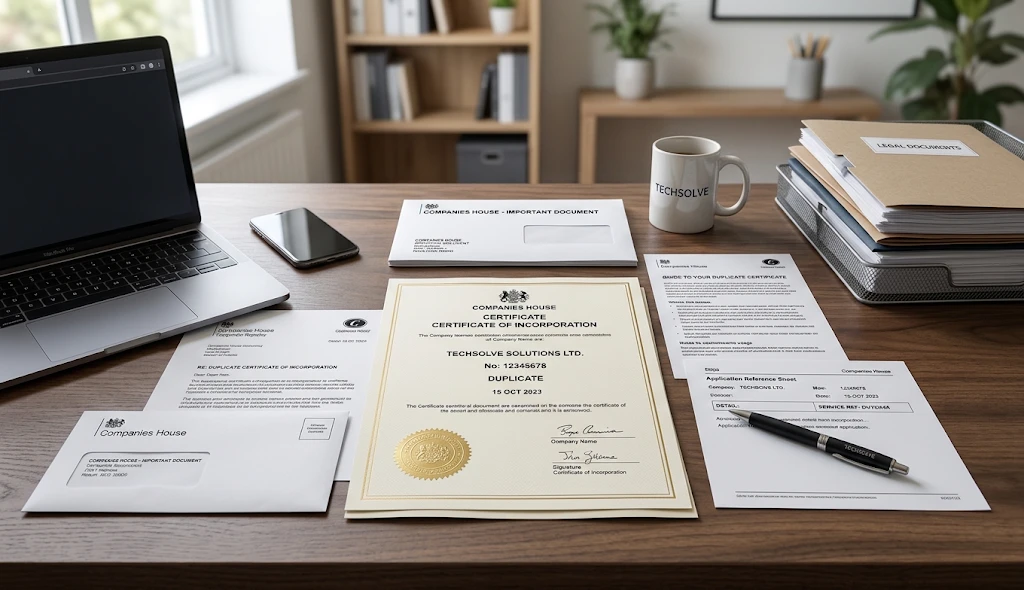
You replace a lost Certificate of Incorporation from abroad by requesting an official replacement document from Companies House or utilizing specialized corporate filing services. Expedited filing services process duplicate requests online, delivering authenticated replacement credentials directly to international directors.
Non-UK resident directors face distinct practical hurdles when requesting official document duplicates across foreign time zones. Accessing government registries directly often requires navigating complex filing portals and complying with specific document verification formats. Utilising a dedicated service provider simplifies administrative steps for international business owners.
When your commercial operations require quick document replacement, choosing a targeted solution like a Duplicate Certificate of Incorporation restores your compliance standing efficiently. Professional filing providers interface directly with Companies House to extract official electronic copies and deliver certified legal replacements.
Understanding the exact step-by-step procedures prevents operational downtime. International entrepreneurs managing corporate records from overseas can follow comprehensive guides such as Step-by-Step: How to Replace Lost UK Corporate Documents From Another Time Zone to maintain compliance across all jurisdictions.
What Other Essential Corporate Documents Work Alongside Your Incorporation Certificate?
The Memorandum of Association, Articles of Association, Share Certificates, and Register of Officers work alongside your Certificate of Incorporation. Together, these legal instruments define internal governance rules, share ownership distribution, and management authority for the entity.
A Certificate of Incorporation proves the entity's existence, but supplementary records define corporate operation. The Memorandum of Association confirms the original subscribers' intention to form the legal entity. The Articles of Association establish the internal legal framework governing director powers, voting rights, and administrative procedures.
Share certificates document legal ownership percentages held by individual shareholders. Maintaining an up-to-date Register of Officers confirms who holds legal authority to execute contracts on behalf of the company. Corporate authorities and external auditors inspect these supplementary files alongside your primary incorporation document.
International regulatory bodies often request a complete set of legal documents during formal audits. Combining your incorporation proof with updated governance records ensures total compliance with UK corporate law requirements.
How Does Non-Resident UK Company Formation Support Your International Business Growth?
Non-Resident UK Company Formation supports international business growth by delivering tailored UK incorporation, document retrieval, and ongoing administrative services designed specifically for non-UK residents. The platform simplifies international compliance and resolves administrative challenges for overseas entrepreneurs.
Overseas business owners face specific legal requirements when managing UK corporate entities from abroad. Non-Resident UK Company Formation provides dedicated corporate administrative services tailored exclusively to international founders. The service streamlines official registry communication and ensures overseas directors satisfy all UK statutory obligations.
Maintaining complete administrative control over your UK corporate structure requires reliable execution. Non-Resident UK Company Formation handles document replacement, statutory filings, and official registry updates seamlessly. International entrepreneurs gain peace of mind knowing their legal credentials remain fully compliant, allowing them to focus on scaling global commercial operations.


0 comments
No comments yet — be the first to share your thoughts.