
Do Overseas Directors Need to Be in the UK to Change a Company Name?
Overseas directors do not need to travel to the UK to change their company name. Discover the online process, Companies House requirements and essential steps for updating your UK company's registered name remotely.
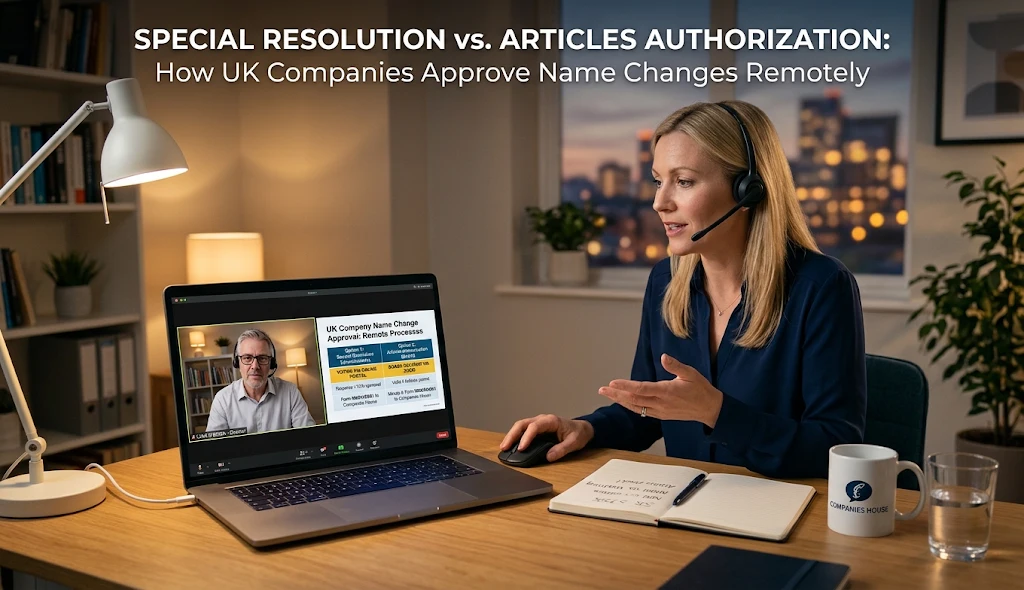
No, overseas directors do not need to be physically present in the United Kingdom to change a UK company name. The entire name change process takes place online through electronic filing systems, allowing international directors to complete all statutory filings, resolutions, and identity verifications remotely from any location worldwide.
Changing an existing UK business identity represents a major corporate decision for international business owners. Overseas directors manage corporate structures across global borders while maintaining full compliance with United Kingdom corporate law. Understanding the electronic filing systems of Companies House ensures a seamless brand transition without travel requirements.
How Do Non-Resident Directors Change a UK Company Name Online?
Overseas directors change a UK company name by passing a formal resolution, submitting electronic form NM01 through web filing services, and paying the statutory filing fee online. Companies House processes complete applications digitally without requiring physical presence, paper forms, or UK-based legal representation.
International directors execute corporate changes remotely through secure online portals. The process begins with internal corporate approvals within the business structure. Directors draft and pass either a special resolution or a board resolution, depending on the provisions set out in the company's articles of association. A special resolution requires approval from at least 75 per cent of voting shareholders.
Once shareholders approve the proposed change, the company submits Form NM01 electronically to Companies House. The submission system requires the company's Web Filing Authentication Code to validate the filing authority. Online submissions processing completes rapidly when all submitted information matches official registry records exactly. Companies House returns the digital Certificate of Incorporation on Change of Name directly to the corporate online dashboard.
Corporate officers track their filing status through digital confirmation emails. A company can be formed online in as little as 3 working hours when complete and accurate information is submitted, and all necessary legal and ID checks are completed. The same efficient digital infrastructure processes corporate updates for non-resident business entities. Your Web Filing Authentication Code will be provided online through your company summary page.
Processing times depend on Companies House processing and exclude weekends and bank holidays. Delays can occur where information or documents are incomplete or incorrect, or where technical or application-related complexities require additional processing. Overseas business owners maintain control over their corporate identity updates by adhering to standard electronic filing rules.
What Legal Documentation Is Required for a Remote Name Change?
A remote UK company name change requires a written special resolution, a completed electronic Form NM01, updated constitutional documents, and verified director identification credentials. Directors store these records in the statutory registers while filing the required notices electronically with Companies House.
Legal documentation establishes official corporate intent and satisfies regulatory requirements under the Companies Act 2006. Directors prepare written resolutions rather than holding physical general meetings. Written resolutions allow non-resident shareholders living in different time zones to cast votes electronically. Three distinct verification records validate the resolution: digital signatures, email confirmations, and signed resolution physical copies uploaded as digital PDF documents.
Form NM01 serves as the primary statutory notice for changing a company name by special resolution. The form requires precise corporate identification numbers, the exact new company name, and confirmation of resolution approval dates. Submitting identical legal names across all documentation prevents administrative rejections from registry officials.
When companies alter their corporate names, they must review their articles of association. If the articles dictate specific rules regarding name changes, directors must submit amended constitutional documents alongside Form NM01. Maintaining detailed minute books protects non-resident boards during corporate compliance audits.
Professional administrative providers streamline these filing requirements for international corporate boards. Non-resident business owners often rely on professional Non-Resident Company Name Change management to verify documents, draft resolutions, and submit electronic filings correctly. Proper administrative handling eliminates filing errors and preserves corporate standing.
Which Name Rules Must International Directors Check Before Filing?
International directors must check that the proposed name is available, contains no sensitive words, avoids matching existing trademarks, and ends with a permitted corporate designation like Limited or Ltd. Registrar guidelines reject names that mislead the public or copy existing registered entities.
Companies House enforces strict naming regulations to maintain transparency in the United Kingdom corporate register. Overseas business owners must evaluate their proposed brand name against existing corporate entries before passing shareholder resolutions. Two distinct rules govern string comparisons: exact matches and "same as" name regulations.
The "same as" rule treats specific punctuation, spacing, and word variations as identical. For example, web spaces, punctuation marks, and common words like "UK" or "Services" do not create sufficient differentiation between two entity names. Directors must ensure their proposed corporate identity remains distinct from all active registrations.
Sensitive words and expressions require explicit official authorisation before registration. Words suggesting government connection, financial authority, or professional accreditation demand supporting documentation from relevant regulatory bodies. Two examples of restricted terms include "Bank" and "Royal," which require written non-objection letters prior to submission.
When non-resident business owners submit names containing restricted terms without permission, registry officials reject the filing immediately. Understanding What to Do When a Proposed UK Company Name Fails the Availability Check helps directors select alternative naming strategies, secure regulatory approvals, and resubmit electronic documentation without disrupting business timelines.
How Does Identity Verification Work for Non-Resident Corporate Officers?
Identity verification for non-resident directors uses secure digital identity platforms to check passports, national identity cards, biometric data, and proof of residential address remotely. Officers complete verification steps entirely online without visiting UK government offices or embassies.
United Kingdom corporate regulations enforce strict transparency standards for company directors and beneficial owners. Non-resident corporate officers must prove their identity when managing statutory corporate records. Digital verification tools enable overseas individuals to satisfy compliance mandates from their home countries.
The electronic verification process operates through accredited identity service providers. Directors upload high-resolution photographic documents to secure platforms. Three primary verification credentials satisfy statutory identity rules: biometric passports, national identity cards, and utility bills issued within the last three months.
Advanced biometric software matches facial scans taken on mobile devices against the uploaded photo identification documents. The system validates document security features, checking watermarks, MRZ lines, and holographic images against global database records. Automated checks verify data integrity within minutes.
International business structures operating from multiple jurisdictions complete these compliance steps simultaneously. Digital identity verification ensures international companies meet anti-money laundering regulations while maintaining operational efficiency across international borders.
What Happens After Companies House Approves the Name Change?
After approval, Companies House issues a digital Certificate of Incorporation on Change of Name, updates the public register, and officially changes the company's legal title. The business must then update bank accounts, tax records, domain names, contracts, and legal stationery.
Approval of Form NM01 marks the legal establishment of the new company name. Companies House generates an electronic Certificate of Incorporation on Change of Name. This document serves as legal proof that the corporate entity altered its name while maintaining its original unique company registration number.
The public corporate register updates its database entries immediately upon issuing the certificate. However, the legal entity retains all existing legal liabilities, contractual obligations, and property rights. The name change creates no new legal persona; it updates the identifier of the existing corporate body.
Non-resident directors must execute several administrative tasks following formal registration. Three essential post-approval updates include: amending corporate bank account records, updating HM Revenue and Customs tax files, and re-issuing commercial agreements under the new legal title. Banks require certified copies of the name change certificate before updating business accounts.
Displaying updated corporate identifiers remains a mandatory statutory requirement under UK business law. Companies must update websites, email signatures, invoices, ordering forms, and commercial letterheads immediately. Displaying incorrect corporate titles risks civil penalties under United Kingdom corporate disclosure regulations.
Why Do Non-Resident Companies Use Online Formation Services?
Non-resident companies use online formation services to navigate United Kingdom corporate regulations, manage electronic filings accurately, secure registered office addresses, and maintain statutory compliance remotely without requiring local physical presence.
Managing a United Kingdom corporate entity from overseas requires reliable administrative support tailored to international operational environments. Overseas business owners face unique challenges related to time zone differences, postal delays, and unfamiliar regulatory frameworks. Specialised formation providers eliminate operational friction by handling administrative requirements directly.
Professional corporate service firms provide dedicated digital dashboards for managing company filings. These systems store Web Filing Authentication Codes securely, track statutory compliance deadlines, and generate pre-formatted corporate resolutions. Automated administrative oversight prevents forgotten filings and avoids late submission penalties.
International corporate structures benefit from specialised administrative address services. UK law requires every registered company to maintain an official registered address within its jurisdiction of incorporation. Administrative providers supply compliant UK addresses, receive official government correspondence, and scan documents for instant electronic delivery to overseas directors.
Working with experienced support providers allows international entrepreneurs to scale business activities within the United Kingdom market confidently. Dedicated professional assistance ensures corporate filings adhere strictly to regulatory standards, protecting the long-term standing of the international business enterprise.
Non-Resident UK Company Formation provides dedicated corporate setup and ongoing administrative support designed exclusively for international entrepreneurs. Overseas directors manage company name changes, annual filings, and legal compliance seamlessly through structured online business management services.



0 comments
No comments yet — be the first to share your thoughts.