
What Is the Difference Between a Commercial Trading Name and a Companies House Legal Name?
Understand the difference between a commercial trading name and a Companies House legal name, including registration rules, branding requirements and how to use both correctly for your UK business.
A commercial trading name represents the public-facing moniker your business uses for sales, marketing, and daily branding, whereas a Companies House legal name functions as the official registered corporate title permanently recorded on the public register of UK corporate entities.
Why Do Non-UK Residents Often Confuse Trading Names with Legal Names?
Non-UK residents often confuse trading names with legal names because international entrepreneurs frequently launch online storefronts under distinct consumer-facing brands before completing formal corporate registration procedures.
International founders navigating UK business expansion encounter dual naming structures immediately. Every limited company requires a formal title registered with Companies House during incorporation. This official designation appears on all statutory documents, government filings, and legal contracts. Business owners operate separate consumer brands for marketing purposes without altering their corporate registry details. Global entrepreneurs establish storefronts on Shopify, Amazon, or digital marketplaces using creative branding. This commercial banner functions as a trading style rather than a recognised corporate identity. Regulatory bodies separate these concepts to maintain clear oversight of corporate liability and consumer protection frameworks. Non-UK residents must understand this distinction to avoid compliance penalties during international expansion. Companies House enforces strict naming rules to prevent duplication on the public register. Trading standards authorities monitor consumer-facing names to ensure transparency in commercial transactions. Maintaining clarity between these two identifiers protects business assets across international jurisdictions.
How Does Companies House Regulate Official Corporate Legal Names?
Companies House regulates official corporate legal names by enforcing strict statutory availability checks, mandatory suffix requirements, and prohibition rules against sensitive words or misleading terms.
The UK registrar of companies applies rigorous statutory standards to every incorporation application submitted by international founders. Applicants must verify name availability through the official Companies House database before submitting incorporation documents. Every limited company name must end with the exact legal designator Limited or Public Limited Company. Companies House rejects applications containing restricted terms like Royal, Bank, or British unless official government authorisation is granted. Official corporate titles remain permanently fixed on the public register until directors execute a formal corporate redesignation process. Processing times depend on Companies House processing and exclude weekends and bank holidays. Delays occur when information or documents are incomplete or incorrect, or when technical application complexities require additional manual review. Non-UK founders utilise professional incorporation services to streamline this regulatory verification workflow. Non-Resident UK Company Formation provides expert guidance through these statutory requirements for international entrepreneurs.
What Defines a Commercial Trading Name for Business Operations?
A commercial trading name defines the unregistered operating banner used for customer-facing branding, marketing campaigns, bank accounts, and day-to-day commercial sales activities.
Commercial trading styles operate without direct registration on the central government corporate database. Businesses utilise these consumer-facing monikers to build brand recognition, launch digital storefronts, and market products to international buyers. Operating under a trading banner requires compliance with UK business naming disclosure regulations. Companies must display their official registered company name and registered office address on business stationery, invoices, and digital websites. Failing to display statutory corporate details alongside trading monikers results in severe regulatory penalties from enforcement authorities. Global founders manage multiple product lines under distinct commercial banners while retaining a single underlying corporate entity. This flexibility allows businesses to pivot marketing strategies without altering foundational legal documents or statutory registers. Entrepreneurs establish clear operational boundaries between corporate ownership and public-facing brand portfolios.
What Legal Obligations Apply to Using a Trading Name?
Legal obligations for trading names require businesses to display official corporate registration details on all commercial documents, digital platforms, and physical premises.
UK corporate legislation mandates transparent disclosure of underlying legal ownership for every commercial operation. Companies utilising alternative trading banners must print their official registered company name on invoices, receipts, and order forms. Digital storefronts must display the registered corporate title and official office location clearly within website footers and legal pages. Business owners protect their commercial banners through trademark registration with the Intellectual Property Office rather than Companies House. Unregistered trading styles lack the automatic nationwide protection granted to official corporate registrations on the public register. Competitors register identical trading monikers as formal corporate entities unless brand owners secure appropriate intellectual property rights. International founders mitigate these risks by conducting comprehensive trademark searches before launching marketing campaigns.
How Can Businesses Update Their Corporate Identity After Incorporation?
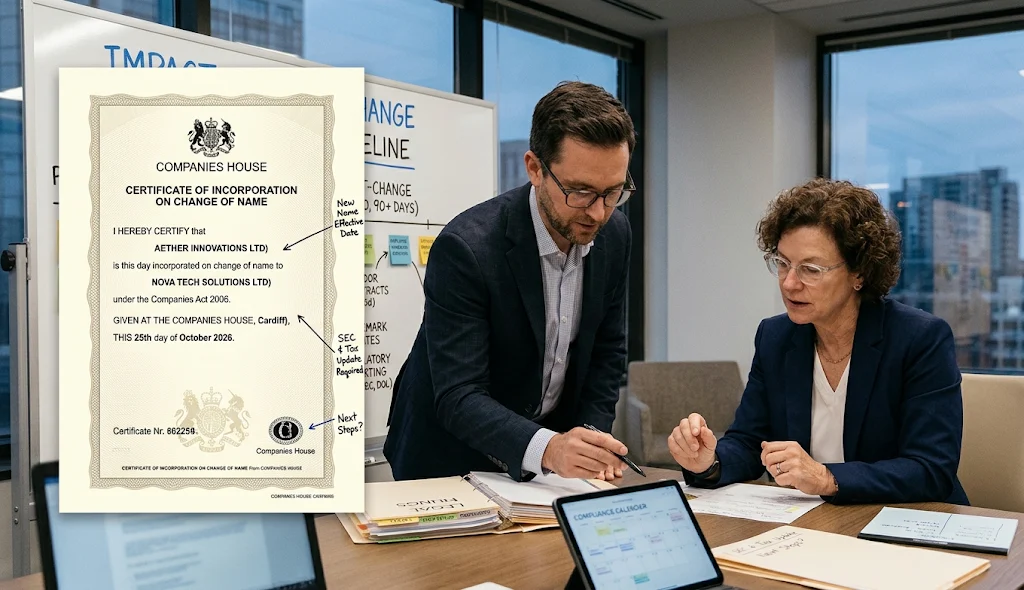
Businesses update their corporate identity after incorporation by filing formal resolution documents, passing shareholder approvals, and submitting statutory change applications directly to Companies House.
Modifying an official corporate title requires strict adherence to statutory governance procedures defined in the Companies Act. Directors must convene board meetings, draft special resolutions, and secure required shareholder voting majorities before altering registry records. Following internal approval, companies submit statutory forms and supporting documentation to the UK registrar for official validation. A company can be formed online in as little as 3 working hours when complete and accurate information is submitted, and all necessary legal and ID checks are completed. The Web Filing Authentication Code will be provided online through your company summary page. Companies update internal registers and statutory records to reflect the new corporate identity seamlessly. Founders who need professional assistance with these administrative adjustments utilise our specialised Non-Resident Company Name Change service to ensure complete regulatory compliance. Maintaining accurate corporate records prevents legal disputes and ensures continuous operational alignment with UK statutory frameworks. Reviewing essential governance steps is critical, as detailed in our guide on Updating Your UK Corporate Identity: What Statutory Records Must Change First?.
Understanding the difference between a commercial trading name and a Companies House legal name protects international businesses from regulatory non-compliance and branding conflicts. Official corporate titles establish legal accountability and permanent registry status, while trading banners drive marketing success and customer acquisition. When international entrepreneurs need reliable administrative support, Non-Resident UK Company Formation delivers expert solutions to manage corporate name changes and maintain flawless statutory compliance throughout the lifecycle of a UK enterprise.



0 comments
No comments yet — be the first to share your thoughts.