
Why Official Certificates of Incorporation on Change of Name Matter for Global Verification
Official Certificates of Incorporation on Change of Name provide essential proof of a company’s legal identity, supporting global verification, international banking, compliance checks and trusted business transactions worldwide.
Official certificates of incorporation on a change of name matter for global verification because they provide legally authenticated proof of corporate identity, prevent cross-border compliance rejections, and authenticate structural transitions during international business verification audits.
Why Do Global Authorities Require Updated Incorporation Proofs?
Global authorities require updated incorporation proofs because international regulators mandate authentic documentation to verify active legal entities, trace historical corporate lineages, and prevent cross-border fraud during regulatory audits.
Cross-border regulatory bodies enforce strict corporate transparency laws across 195 jurisdictions. Foreign banking institutions and tax authorities reject unverified corporate documentation because entities frequently alter their registered identifiers. When global financial partners review a corporate structure, they require certified proof from Companies House to trace the legal lineage from the initial incorporation event to the current operational status. International verification protocols demand official registry documentation rather than self-reported statements because regulatory penalties for accepting unverified foreign entities exceed 5,000,000 dollars in major financial sectors.
How Do Name Alterations Impact International Banking Compliance?
Name alterations impact international banking compliance because discrepancies between legacy registry records and current trade titles trigger immediate account freezes, mandatory re-verification cycles, and compliance investigations.
Global financial institutions maintain automated compliance screening systems that flag name discrepancies between corporate registry profiles and transactional records. When a UK corporate entity modifies its registered title through Companies House, international banking partners must update their compliance databases within 14 days to maintain operational status. Failure to present authentic validation documents causes compliance officers to suspend wire transfers, freeze merchant accounts, and request certified historical lineage records. 35% of international payment delays occur because corporate entities fail to synchronise their updated statutory titles with foreign banking compliance departments before initiating transactions.
What Constitutes a Validated Corporate Identity After Rebranding?
A validated corporate identity after rebranding consists of the original incorporation document, the official name change certificate, and an apostilled company summary displaying the current operational status.
International legal frameworks require a complete sequence of statutory instruments to establish legal continuity after a corporate rebranding process. The verification package must include the initial certificate issued at incorporation alongside the secondary certificate confirming the subsequent title transition. Foreign legal authorities examine these documents concurrently to verify that corporate liabilities, asset ownership holdings, and contractual obligations transfer legally across the administrative alteration. Legal verification teams authenticate these records by checking digital validation codes issued by official government registries to confirm that the documents remain unaltered.
Why Do Foreign Trademark Offices Demand Official Registry Proofs?
Foreign trademark offices demand official registry proofs because intellectual property examiners must verify that the applicant entity holds active legal standing under its exact current commercial title.
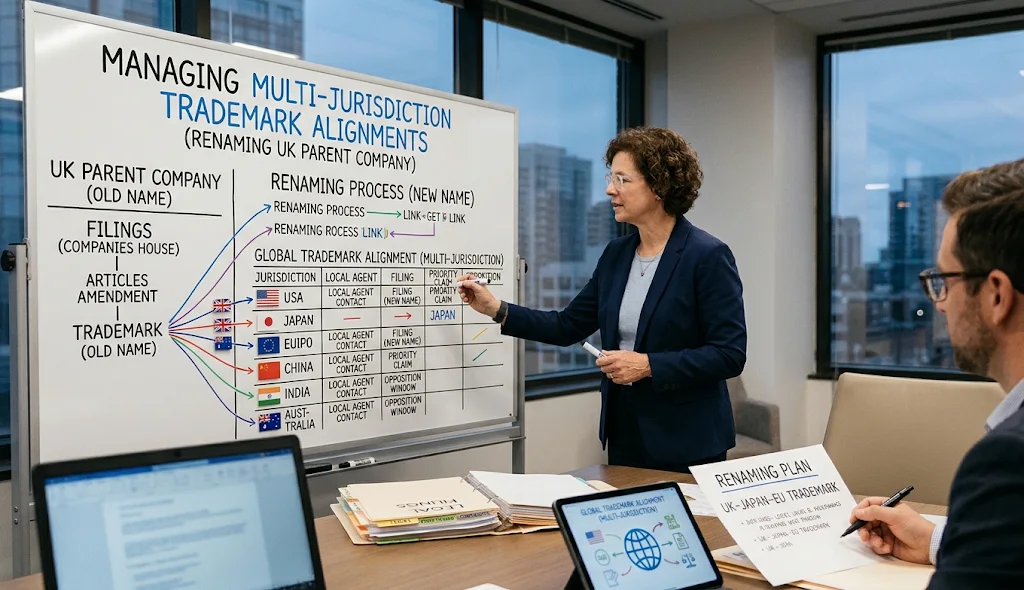
Intellectual property registration offices across 140 jurisdictions enforce strict applicant validation rules to prevent fraudulent filings and protect brand ownership rights. When a corporate entity submits an international trademark application following a corporate title modification, IP examiners cross-reference the submission data against official government registers. Examiners reject applications instantly if the applicant name differs from the active registry profile without an official certificate demonstrating the legal transition. Trademark registration: Why Official Certificates of Incorporation on Change of Name Matter for Global Verification
Official Certificates of Incorporation on Change of Name authenticate updated corporate identities for international regulators, foreign banking institutions, and cross-border commercial partners by establishing a certified, tamper-proof legal trail directly from Companies House registers.
What Is an Official Certificate of Incorporation on Change of Name?
An official certificate of incorporation on change of name is a legal document issued by Companies House that validates a UK company's new corporate title and certifies its legal continuity under the updated identifier.
This statutory document serves as the definitive legal proof of corporate evolution for global entities. International compliance officers inspect this certificate to trace corporate history during onboarding procedures. Foreign regulatory bodies require this proof to update register entries without disrupting commercial operations. Global verification frameworks rely on this instrument to prevent identity fraud and corporate impersonation. Overseas banking institutions request this certified record to update account titles and maintain strict anti-money laundering compliance.
Why Do Global Regulators Require Certified Name Change Proof?
Global regulators require certified name change proof because cross-border verification demands verifiable proof of corporate continuity from an authoritative government registry before updating domestic business registers.
International oversight bodies reject plain text declarations because corporate integrity requires verifiable government stamps. Foreign authorities validate corporate legitimacy by inspecting official registrar seals and unique authentication codes. Overseas compliance teams review these documents to confirm that the legal entity remains identical despite the title modification. Two verification methods secure this process: holographic registrar seals and digital authentication certificate hashes. Cross-border institutions examine these security markers to prevent fraudulent corporate restructuring and illicit financial routing.
How Do International Banks Verify Updated UK Company Names?
International banks verify updated UK company names by demanding official confirmation documents that link the historical corporate identifier directly to the current registered title.
Global financial institutions operate under stringent regulatory mandates that prohibit account title modifications without official proof. Compliance departments inspect the certificate of incorporation for a change of name to cross-reference registry databases maintained by Companies House. Financial officers examine four specific corporate identifiers: registration numbers, incorporation dates, historical titles, and current business names. Banks reject uncertified board resolutions because financial regulations dictate reliance on official registrar output. Account managers update commercial ledgers only after authenticating the electronic certificate through official verification portals. Foreign financial entities also evaluate related procedures detailed in our guide on Why One-Off Statutory Services Outperform DIY Submissions for Remote Rebranding.
What Role Do Official Certificates Play in Cross-Border Contracts?
Official certificates play a critical role in cross-border contracts by legally binding past commercial obligations executed under an older name to the newly rebranded corporate entity.
Global commercial partners demand legal certainty before executing high-value international trade agreements with rebranded enterprises. Legal counsel inspects the official name change certificate to verify that existing liabilities transfer seamlessly to the updated corporate structure. Cross-border litigation frameworks recognise this government-issued certificate as conclusive evidence of uninterrupted corporate identity. International arbitration panels review these documents to resolve jurisdictional disputes regarding contractual obligations incurred prior to corporate rebranding. Commercial entities mitigate legal risks during international expansion by attaching certified name change histories to master service agreements. Businesses evaluating structural changes often research related impacts by reading Do International Trademark Conflicts Affect Your Companies House Name Registration? to ensure complete name alignment.
How Do Global Compliance Officers Validate Registrar Authentication?
Global compliance officers validate registrar authentication by verifying digital signatures, cryptographic hashes, and official filing numbers embedded within the electronic certificate issued by Companies House.
Modern compliance protocols require instant verification of digital government documents across international jurisdictions. Compliance officers query official registry databases using unique web filing authentication codes to confirm document validity. Two validation techniques dominate international screening: cryptographic hash verification and secure portal registry lookups. International auditors cross-examine these data points to eliminate risks associated with fraudulent document fabrication. Regulatory compliance frameworks mandate strict document provenance standards to protect global financial systems from bad actors. Securing these vital documents ensures seamless international operations, a core competency delivered through our specialised Non-Resident Company Name Change framework.



0 comments
No comments yet — be the first to share your thoughts.