
How Can Non-Resident Directors Maintain Complete UK Corporate Paperwork Remotely?
Discover how non-resident UK directors can manage statutory records, company documents, official correspondence and compliance requirements remotely while keeping corporate paperwork organised, secure and accessible from anywhere in the world.
Non-resident directors maintain complete UK corporate paperwork remotely by storing digital copies of incorporation documents, filing statutory updates through Companies House online, keeping statutory registers current, and ordering official certified copies, such as a duplicate certificate of incorporation, whenever third parties require proof.
Which UK Corporate Documents Do Non-Resident Directors Keep?
A UK limited company keeps five core record types: the certificate of incorporation, articles of association, statutory registers, annual accounts, and confirmation statements. Each record proves the company exists, who controls it, and whether it meets Companies House filing duties.
The certificate of incorporation is the foundation document. It records the company name, the company number, and the incorporation date. Banks, payment providers, and marketplaces ask for it first.
The articles of association set the internal rules. They define director powers, share transfers, and decision-making procedures. Companies House holds a copy of the articles filed at incorporation.
Statutory registers form the third layer. Under the Companies Act 2006, every company maintains a register of members, a register of directors, and a register of people with significant control (PSC). Private companies file accounts and an annual confirmation statement. These records show the company’s financial position and its current officers.
A non-resident director holds all five record types in digital form. Digital storage removes the dependence on a physical office in the United Kingdom.
How Quickly Can a Non-Resident Form a Company and Receive Its First Documents?
A company is formed online in as little as 3 working hours when complete and accurate information is submitted, and all necessary legal and ID checks are completed. The Web Filing Authentication Code appears on the company summary page.
Processing times depend on Companies House processing. Weekends and bank holidays are excluded from the count. A submission on a Friday evening therefore continues on the next working day.
Delays occur where information or documents are incomplete or incorrect. Technical or application-related complexities also extend processing. A mismatch between a passport name and the name on the application is one example. An incomplete address field is another.
The Web Filing Authentication Code is a six-character credential. It authorises online filings with Companies House, including confirmation statements and officer changes. A non-resident director stores this code in a password manager. Possession of the code is the first step toward remote filing control.
Once the company is incorporated, the first records exist. The certificate of incorporation, the registered company number, and the company summary page form the opening document set. A director downloads and archives each item on the day of incorporation.
How Do Non-Resident Directors File Companies House Updates Online?
Directors file updates through the Companies House online service using the company number and the Web Filing Authentication Code. Online filing covers confirmation statements, officer changes, registered office changes, and annual accounts, with no UK postal address required for submission.
A confirmation statement is due at least once every 12 months. It confirms the company’s registered office, officers, share capital, shareholders, and PSC details. A late statement exposes the company to enforcement action and a possible strike-off.
Private limited companies file annual accounts within 9 months of the financial year-end. The first accounts follow a different deadline, calculated from the incorporation date. A director records both deadlines in a digital calendar.
Officer changes carry a 14-day filing window. A change of director address, a resignation, or a new appointment is filed within that period. The same 14-day rule applies to changes in PSC details.
Identity verification is now part of the Companies House framework for directors and PSCs. A director completes verification once and links it to future filings. Verified status protects the company record from unauthorised changes.
How Do Non-Resident Directors Keep Statutory Registers Current From Abroad?
Directors keep statutory registers current by updating the register of members, directors, and PSCs within days of each change. Registers are maintained electronically, stored in a secure cloud folder, and reconciled against Companies House records after every filing.
The register of members records each shareholder, their share class, and the transfer date. A share allotment or transfer triggers an immediate update. The register of directors lists each officer with appointment and resignation dates.
The PSC register identifies individuals holding more than 25% of shares or voting rights. It also covers individuals who hold the right to appoint or remove a majority of directors. Each PSC entry carries a date, a name, and the nature of control.
Reconciliation is the key control. After each Companies House filing, the director compares the public record with the internal register. A mismatch between the two signals an unfiled change or a clerical error. The director corrects the discrepancy the same day.
Companies hold registers at the registered office or at a single alternative inspection location. Electronic registers satisfy the Companies Act 2006 when they are available for inspection on request. Version control matters. The director saves each register as a dated file, for example “register-of-directors-2026-11-11.pdf”.
When Does a Duplicate Certificate of Incorporation Protect Your Paperwork?
A Duplicate Certificate of Incorporation replaces a lost, damaged, or unavailable original and gives the company an official record of incorporation. Third parties accept the duplicate as proof of the company’s legal existence and registration details.
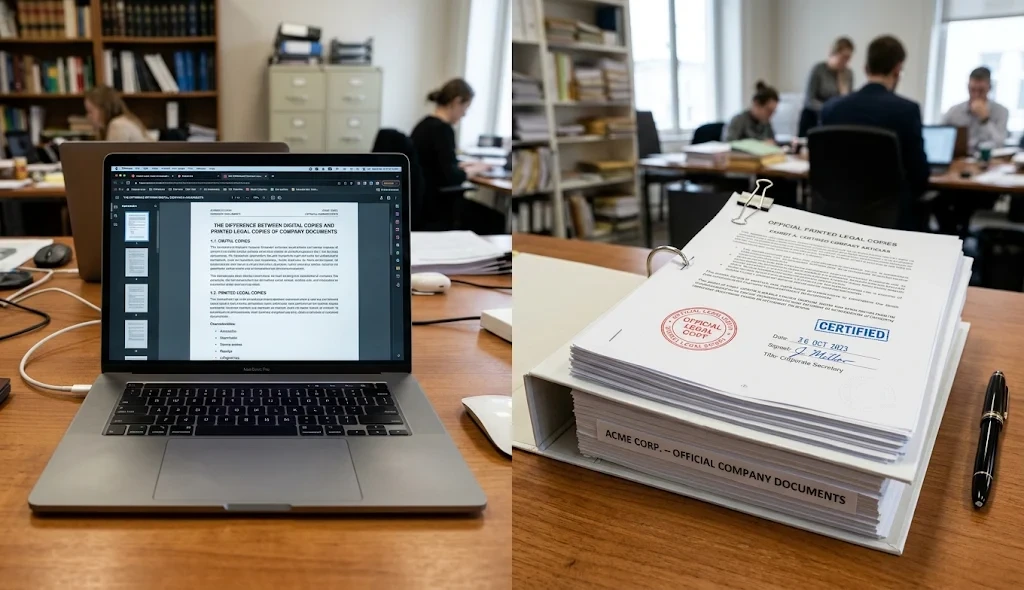
Original certificates are lost in international moves, courier errors, and storage failures. A scanned copy is not equal to an official document. Banks, regulators, and overseas counterparties request official proof of incorporation. A standard printout of the company summary page does not meet that standard in every case.
Non-resident directors face this problem more often than UK-based directors. The original certificate travels with the company’s formation documents. A lost parcel leaves the company without its primary proof of existence. A Duplicate Certificate of Incorporation restores the official document and closes that gap.
The duplicate carries the same core details as the original. These include the company name, company number, and incorporation date. A director orders the duplicate as soon as the original goes missing. Prompt replacement prevents delays in bank onboarding, contract signing, and tender submissions.
Directors who plan hold one spare official copy in a separate location. Redundancy protects the paperwork chain. The extra copy also supports requests from two parties at the same time, such as a bank in one country and a licensing authority in another.
Understanding the gap between a printout and an official record matters. Read why standard printouts fail when third parties demand official incorporation proof for a detailed comparison of document types and their acceptance rates.
What Is the Best System for Storing UK Corporate Paperwork Remotely?
The best system combines three layers: encrypted cloud storage, a dated naming convention, and a quarterly audit. This structure protects every UK corporate record and gives a director access from any country within minutes.
Encrypted cloud storage forms the first layer. Directors choose a provider with two-factor authentication and access logs. They create one folder per company with five subfolders: incorporation, registers, filings, accounts, and banking.
A dated naming convention forms the second layer. Each file carries the document type and the date, for example “confirmation-statement-2026-09-30.pdf”. Consistent names make retrieval fast. They also create a clear audit trail.
The quarterly audit forms the third layer. Four times a year, the director checks the Companies House record against the internal archive. The audit covers officer details, registered office, share capital, PSC data, and filing deadlines. Each audit takes under an hour for a single company.
Backup completes the system. A second copy sits with a different provider or on an encrypted drive. Two independent copies protect against account lockouts and provider failures. The Web Filing Authentication Code belongs in a password manager, never in a plain text file or an email draft.
What Does Complete Remote Paperwork Control Look Like?
Complete remote control means every statutory record is current, every filing deadline is tracked, and every official document is replaceable within days. Directors achieve this through digital archiving, scheduled Companies House filings, and verified official copies.
The process reduces to four actions. Archive every document on the day of issue. Update every register within days of each change. File every Companies House submission before its deadline. Replace missing official documents immediately.
Non-Resident UK Company Formation delivers this structure for non-UK residents. The company supports incorporation, the delivery of formation documents, and post-incorporation administration, including the Duplicate Certificate of Incorporation. Its services serve international clients exclusively, so each process addresses the requirements of directors living outside the United Kingdom.
A complete paperwork system turns distance into a manageable variable. Directors who document, reconcile, and verify their records keep their UK company compliant and ready for any third-party request.



0 comments
No comments yet — be the first to share your thoughts.