
Why Do Standard Printouts Fail When Third Parties Demand Official Incorporation Proof?
Standard company printouts often fail to meet third-party verification requirements. Discover why official incorporation proof matters, which documents are accepted, and how to obtain reliable evidence of your UK company registration.
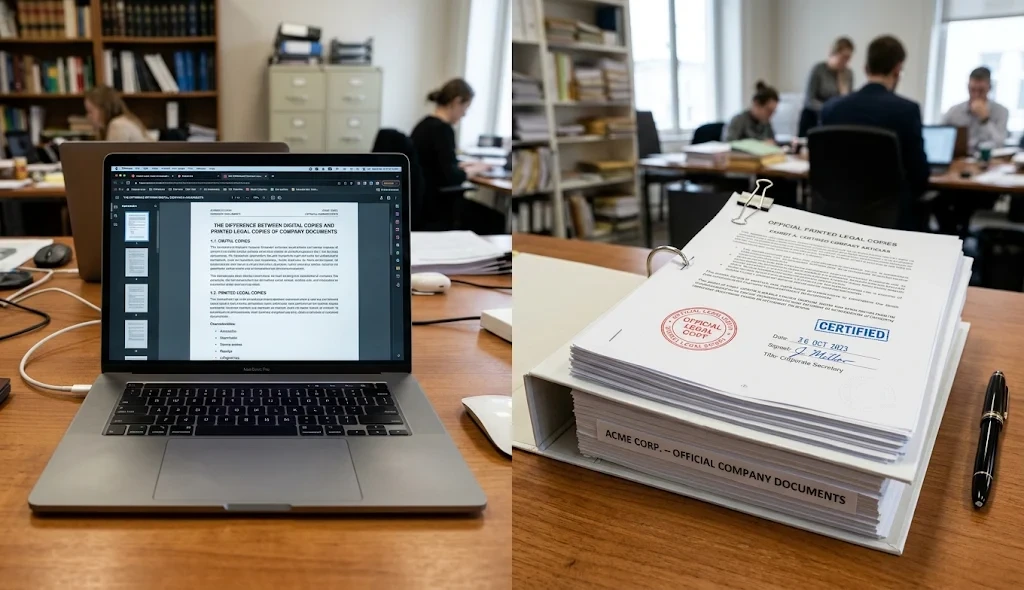
Standard printouts fail because they carry no verifiable authentication. Banks, regulators, and overseas partners require the original Certificate of Incorporation or an official duplicate. A plain printout of a PDF or company summary page lacks the document authority these parties verify against Companies House records.
What Makes an Official Certificate of Incorporation Different From a Standard Printout?
An official Certificate of Incorporation is the legal record Companies House issues when it registers a company. A standard printout only reproduces that record. It confirms nothing on its own, because anyone can edit, recreate, or reprint a page without detection.
Companies House issues the certificate in digital format for online incorporations. The certificate states the company name, the registered company number, and the date of incorporation. These three facts establish that the company exists as a legal entity.
A printout strips away the context that gives the document weight. It shows no chain of custody. The recipient cannot tell whether the page came from Companies House or from a word processor.
Third parties assess authenticity before they assess content. A document that fails the authenticity check stops the process, regardless of how accurate the printed details are. This is the core reason evaluation of proof of incorporation shifts from "does the company exist" to "is this document genuine".
Which Third Parties Reject Standard Printouts?
Three groups reject standard printouts most often: banks, overseas regulators, and notaries. Each group carries a legal duty to verify corporate identity. A document without clear authentication fails that duty, so these parties return the printout and request official proof.
Banks apply customer due diligence rules when they open or maintain a business account. Compliance teams verify the company's legal existence before they approve the relationship. A loose printout does not satisfy that check.
Overseas regulators and licensing authorities apply the same logic. A foreign authority has no direct access to UK systems. It relies on the document in front of it to confirm that the company is real.
Notaries and apostille providers add a third layer. A notary certifies a signature or a copy against an original. A notary cannot certify a copy of a copy. The chain of proof starts with an authentic source document.
For non-resident directors, this problem compounds. The director sits in another country. The company records sit in the UK. Every request from a third party passes through that distance.
What Details Must the Certificate Show to Pass Verification?
The certificate must show four details: the exact company name, the company registration number, the date of incorporation, and the issuing authority. Reviewers match these details against the public Companies House register. Any mismatch triggers rejection.
The company registration number is the primary identifier. Companies House assigns an 8-character number to each company. Reviewers search this number on the public register to confirm status and incorporation date.
The company name must match every other document in the file. A bank compares the certificate name against the application form, the articles of association, and the director's ID. A single spelling difference raises a flag.
The date of incorporation sets the legal start of the company. Compliance teams use it to validate the age of the entity and the sequence of filings.
The issuing authority is the final detail. The certificate must come from Companies House or carry formal certification that traces back to it. A printout from a company summary page shows data, but it lacks the formal certificate wording.
Why Does a Company Summary Printout Fail as Proof?
A company summary printout fails because it is an information page, not a legal certificate. It displays register data. It does not formally certify incorporation. Third parties asking for the certificate expect the certificate document itself.
The company summary page lists the registered office, directors, filing history, and status. This data is accurate and useful. Directors use it daily to check the state of the company.
The page serves a different function from the certificate. The summary informs. The certificate certifies. Reviewers ask for the certificate because it is the single document that records the formal act of incorporation.
Printing a summary also introduces a time problem. The page reflects the register on the date of printing. Reviewers cannot confirm that date from the paper. They treat the printout as unverified and request the certificate.
How Does a Duplicate Certificate of Incorporation Solve the Problem?
A duplicate Certificate of Incorporation replaces a lost, damaged, or unavailable original with an official replacement. It carries the same company details as the original. Third parties accept it as formal proof because it follows the standard certificate format.
Directors lose access to originals for ordinary reasons. Documents get misplaced during a change of address. Digital files sit on a former adviser's system. The original arrives damaged in transit. Each case leaves the director with printouts and no authentic certificate.
The Duplicate Certificate of Incorporation service delivers an official replacement for third-party verification. The director orders the duplicate and receives a document that reviewers recognise. This closes the gap between what the director holds and what the third party demands.
A duplicate carries practical advantages over repeated explanation. The director submits one authentic document. The reviewer verifies the company number against the register. The process moves forward without further correspondence.
The Duplicate Certificate of Incorporation also supports remote administration. A director abroad does not travel to the UK to retrieve paperwork. The replacement reaches the director at an overseas address. The practice of maintaining complete UK corporate paperwork remotely builds on this principle: every key document exists in authentic form before a third party asks for it.
How Quickly Does Companies House Issue the Original Certificate?
A company forms online in as little as 3 working hours when the applicant submits complete, accurate information and completes all required legal and ID checks. Companies House processing times exclude weekends and bank holidays.
The applicant receives the Web Filing Authentication Code through the company summary page. The code authorises online filings with Companies House. Directors store it securely.
Delays occur in three situations: incomplete information, incorrect documents, and technical or application-related complexities that require additional processing. A missing director address, a mismatched name, or an unverified identity each pauses the application.
Accurate submission at the start protects the timeline. It also protects the quality of the certificate. The details printed on the certificate come directly from the submitted application. An error at the application stage appears on the document and surfaces later during third-party verification.
This timeline applies to the original certificate. Once the company exists, the certificate is the permanent record of that moment. Directors who retain it in authentic form avoid the printout problem entirely.
What Does a Non-Resident Director Verify Before Requesting a Duplicate?
A non-resident director verifies three items before requesting a duplicate: the company number, the exact registered company name, and the delivery address. Accurate information prevents delays and ensures the replacement matches the register.
The company number comes first. The director confirms it against the public Companies House register. This check proves the duplicate relates to the correct entity.
The registered name follows. Directors confirm spelling, punctuation, and the company ending, such as "Ltd" or "Limited". Third parties compare these elements character by character.
The delivery address completes the check. Overseas delivery depends on a complete and accurate address, including the postal code and country. Incomplete addresses cause failed deliveries and repeated dispatch. The article on how Royal Mail dispatches replacement certificates to overseas addresses explains the dispatch route in detail.
Directors also confirm which third party requests the proof. Each requester specifies the format it accepts. Matching the duplicate to that requirement avoids a second request.
What Is the Outcome for Non-Resident Directors?
Non-resident directors replace failed printouts with an official duplicate certificate. Third parties accept the replacement, verify the company number, and proceed. Non-Resident UK Company Formation delivers this solution exclusively for non-UK residents.
Standard printouts fail for one reason: they lack authentication. Banks, regulators, and notaries verify the source document first and the content second. A printout of a certificate or company summary page does not pass that test.
An official duplicate passes. It shows the company name, number, and incorporation date in the recognised certificate format. Reviewers match these details against the Companies House register and complete their checks.
Non-Resident UK Company Formation supports international clients through the company formation process and the administration that follows incorporation. The Duplicate Certificate of Incorporation forms part of that support. It gives non-resident directors an authentic document for every third-party request.



0 comments
No comments yet — be the first to share your thoughts.